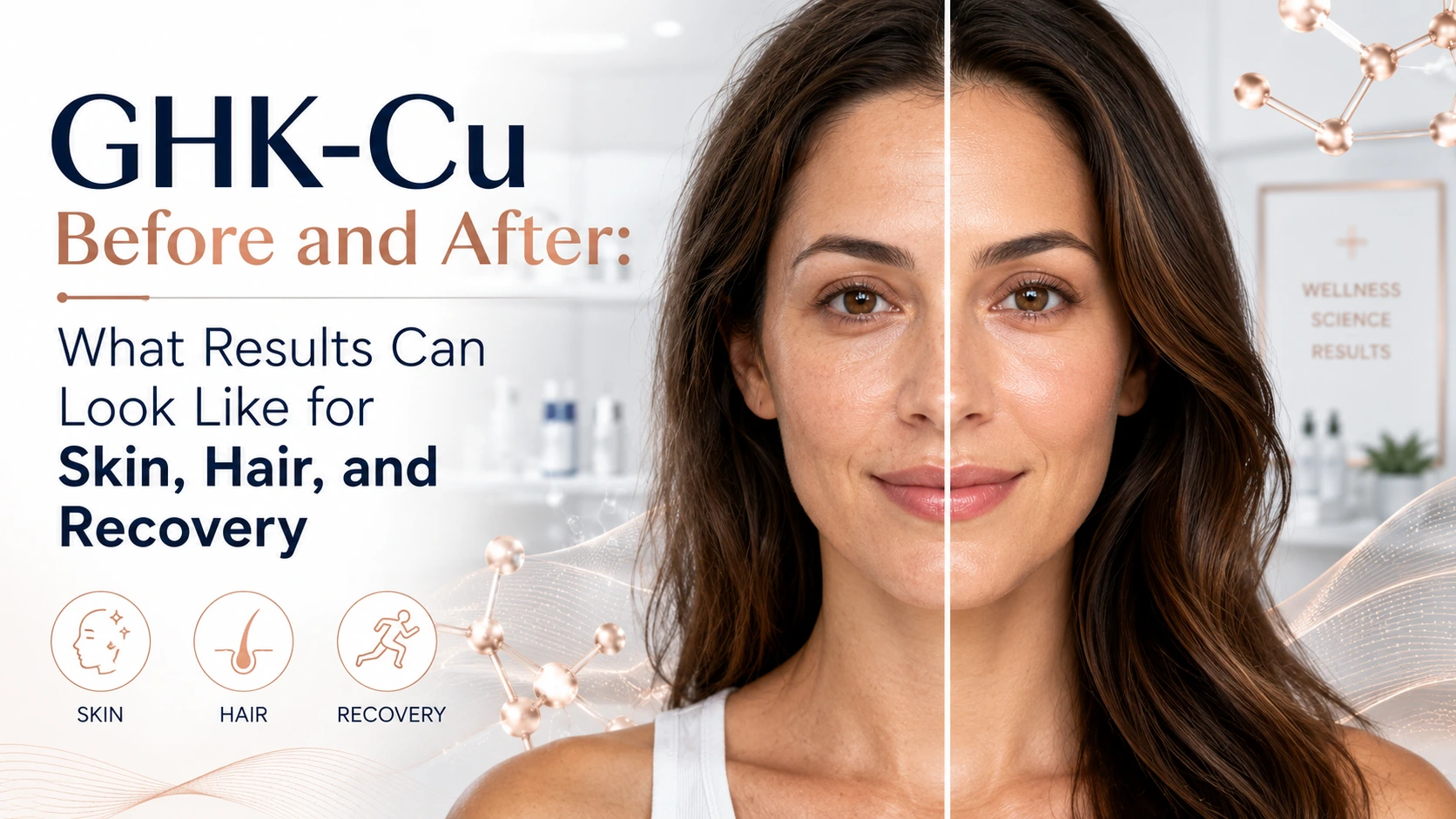
If you are looking up GHK-Cu before and after results, you probably want to know what kind of changes are realistic, how long they take, and whether the photos online tell the full story.
The short answer is that GHK-Cu may support gradual improvements in skin texture, firmness, fine lines, recovery, and overall skin quality.
Some people also use it for hair and scalp support, although hair results tend to take longer and are less predictable than skin results.
Most people do not see a dramatic overnight change.
GHK-Cu works best when expectations are realistic.
Early improvements may show up as smoother, more hydrated-looking skin within a few weeks.
More noticeable changes in firmness, texture, and fine lines often take 6 to 12 weeks.
Hair-related changes may take 3 to 6 months or longer.
At Gard Wellness Solutions in Lantana, Florida, GHK-Cu may be discussed as part of a broader wellness, aesthetic, and regenerative care plan.
The goal is not just to chase a before and after photo, but to understand what is affecting your skin, hair, healing, and overall health.
Key Takeaways About GHK-Cu Before and After Results
GHK-Cu results are usually gradual, not instant.
The most common before and after changes involve smoother skin texture, better hydration, improved firmness, softer-looking fine lines, and healthier-looking skin.
Hair results are possible for some people, but they are more variable.
Hair thinning can be caused by hormones, genetics, thyroid issues, inflammation, nutrient deficiencies, stress, or aging, so GHK-Cu alone may not be enough.
The best way to judge progress is with consistent photos taken in the same lighting, angle, and distance.
Comparing your skin in different lighting or relying on memory can make results harder to evaluate.
GHK-Cu is not a replacement for medical care, cosmetic procedures, or a full treatment plan when deeper skin laxity, advanced hair loss, scarring, or hormone-related concerns are involved.
What Is GHK-Cu?
GHK-Cu is a copper peptide made from three amino acids: glycine, histidine, and lysine.
The “Cu” refers to copper.
In simple terms, GHK-Cu acts like a signaling peptide.
It helps communicate with cells involved in repair, renewal, and tissue remodeling.
It has been studied for its role in skin repair, collagen support, wound healing, inflammation balance, antioxidant activity, and overall tissue health.
GHK-Cu is often discussed in aesthetic medicine because many visible signs of aging are connected to slower repair, collagen loss, oxidative stress, inflammation, and changes in skin structure.
People often look into GHK-Cu for:
- Skin texture
- Fine lines and wrinkles
- Firmness and elasticity
- Dull or tired-looking skin
- Post-treatment recovery
- Scalp and hair support
- General tissue repair
- Healthy aging support
GHK-Cu can be used in different ways, including topical copper peptide skincare products and injectable peptide therapy.
These are not the same, and they should not be expected to produce identical before and after results.
GHK-Cu Before and After Timeline: 2 Weeks, 4 Weeks, 8 Weeks, and 12 Weeks
GHK-Cu before and after results depend on the person, the form used, the quality of the product, consistency, health history, and the concern being addressed.
Still, many people follow a general timeline.
| Timeline | What You May Notice | What to Expect |
| 1 to 2 weeks | Skin may feel more hydrated, calm, or smooth | Early changes are usually subtle |
| 3 to 4 weeks | Texture may look more even, and dullness may improve | This is often when people first notice visible skin changes |
| 6 to 8 weeks | Fine lines may look softer, and skin may appear firmer | Before and after photos may start showing clearer differences |
| 8 to 12 weeks | Skin tone, firmness, and texture may continue improving | This is a more realistic window for visible skin results |
| 3 to 6 months | Hair and scalp changes may become easier to evaluate | Hair results take longer and vary more |
This timeline is not guaranteed.
Some people respond sooner, while others need more time or a more complete treatment plan.
Weeks 1 to 2: Early Skin Feel and Hydration Changes
In the first 1 to 2 weeks, most people should not expect a major transformation.
If changes happen early, they are usually related to how the skin feels.
The skin may feel smoother, less dry, or more comfortable.
Some people notice a subtle hydrated look or less dullness.
These early changes can be encouraging, but they are not usually the full before and after result.
At this stage, GHK-Cu is better judged by consistency than by the mirror.
Skin remodeling takes time.
Weeks 3 to 4: Smoother Texture and Brighter-Looking Skin
By weeks 3 to 4, some people begin to notice more visible changes.
Skin may look smoother, fresher, or more even.
Rough patches may appear softer, and makeup may sit better on the skin.
This is also when people may notice that their skin looks less tired.
The change is usually not dramatic, but it can be noticeable when comparing photos taken under the same conditions.
For people using GHK-Cu for skin quality, this is often the first window where the treatment begins to feel worthwhile.
Weeks 6 to 8: Fine Lines and Firmness May Improve
The 6-to-8-week mark is where GHK-Cu before and after photos often become more meaningful.
Fine lines may look softer, especially if they were made worse by dryness or poor skin quality.
The skin may also appear firmer or more resilient.
This does not mean GHK-Cu creates a facelift-like result.
It is more about improving the quality and appearance of the skin over time.
People with early signs of aging, dull skin, or mild texture changes may notice results more clearly than people with deeper wrinkles or significant laxity.
Weeks 8 to 12: More Noticeable Skin Quality Changes
By 8 to 12 weeks, many people have a better idea of whether GHK-Cu is helping their skin.
Before and after photos may show smoother texture, better tone, softer fine lines, and a healthier overall appearance.
This is also a better time to decide whether the current plan is enough or whether additional support may be needed.
Some people may benefit from combining GHK-Cu with other treatments, skincare changes, hormone evaluation, nutrition support, or aesthetic procedures.
The main point is that GHK-Cu results build gradually.
A fair evaluation usually takes at least a few months.
GHK-Cu Before and After for Face: Texture, Fine Lines, and Firmness
Most people searching for GHK-Cu before and after photos are focused on the face.
Common concerns include fine lines, wrinkles, sagging, dullness, rough texture, and skin that looks tired or thin.
GHK-Cu may help support healthier-looking facial skin by encouraging repair and remodeling processes.
Over time, this may help the skin look smoother, firmer, and more refreshed.
Fine Lines and Wrinkles
GHK-Cu may help soften the appearance of fine lines, especially when those lines are related to dryness, early collagen loss, or poor skin quality.
It is important to be realistic.
Deep wrinkles, advanced volume loss, and significant sagging usually require more than GHK-Cu alone.
In those cases, a provider may recommend a broader plan.
Skin Texture
Texture is one of the most common areas where people look for change.
GHK-Cu may help skin feel smoother and look more even over time.
This can be especially noticeable when someone has roughness, dullness, crepey-looking skin, or uneven tone.
A good before and after comparison should show whether the skin surface looks more refined.
Firmness and Elasticity
Firmness takes longer to notice than hydration.
If GHK-Cu helps improve skin quality, the skin may gradually look more resilient and less tired.
This type of result is usually subtle.
It may not be obvious day to day, but it can show up in photos after 8 to 12 weeks of consistent use.
Dullness and Overall Glow
Some people notice that their skin looks brighter or healthier.
This does not mean the skin is being artificially lightened.
It usually means the skin looks better hydrated, calmer, and more even.
For many people, this “healthier skin” effect is one of the most noticeable parts of their GHK-Cu before and after results.
GHK-Cu Hair Before and After: What Changes Are Realistic?
GHK-Cu hair before and after results are usually more variable than skin results.
Some people use GHK-Cu for thinning hair, shedding, scalp health, or hair quality, but the outcome depends heavily on why the hair is thinning.
Hair loss can be caused by many factors, including genetics, hormones, thyroid issues, stress, inflammation, medications, nutrient deficiencies, illness, and aging.
If those root causes are not addressed, GHK-Cu may not deliver the result someone is hoping for.
Possible hair-related changes may include:
- Less shedding
- A healthier-feeling scalp
- Better hair texture
- Early baby hairs
- Improved density over time
- Thicker-looking existing hair
Hair grows slowly, so it is not realistic to judge GHK-Cu hair results after only a few weeks.
A better timeline is 3 to 6 months.
For hair before and after photos, it is important to take pictures of the same areas each time.
The hairline, temples, crown, and part line should be photographed in consistent lighting.
Injectable GHK-Cu Before and After vs Copper Peptide Serum Results
A major reason GHK-Cu before and after results can look inconsistent is that people are often comparing different types of use.
Someone using a copper peptide serum from a skincare brand may not have the same experience as someone using provider-guided peptide therapy.
The route, concentration, product quality, consistency, and overall plan all matter.
Topical Copper Peptide Serums
Topical copper peptide products are applied directly to the skin.
These may support skin hydration, texture, and overall skin appearance.
Topicals are often easier to use and may be a good option for people looking for skincare support.
However, results depend on the formula, how consistently it is used, and what other products are in the routine.
Some people may experience irritation if they combine copper peptides with too many strong active ingredients at once.
Injectable GHK-Cu
Injectable GHK-Cu is different from a skincare serum.
It is typically discussed in a medical or wellness setting and should only be considered with proper clinical guidance.
A provider can review health history, goals, medications, current symptoms, and whether peptide therapy makes sense.
This matters because not everyone is a good candidate, and product quality and dosing should not be guessed.
People should avoid buying research peptides online and self-injecting.
Sterility, concentration, purity, and safety cannot be assumed from unverified sources.
How to Evaluate GHK-Cu Before and After Photos Online
Before and after photos can be helpful, but they can also be misleading.
Lighting, angles, makeup, filters, facial expression, camera quality, hydration, and other treatments can all change how results appear.
When looking at GHK-Cu before and after photos, ask a few simple questions.
- Were the photos taken in the same lighting?
- Is the face at the same angle?
- Is the person wearing makeup in one photo but not the other?
- Were other treatments used at the same time?
- How long was the person using GHK-Cu?
- Was it topical or injectable?
- Was the result related to skin, hair, or recovery?
- Were the photos edited, filtered, or taken from social media?
The most trustworthy photos are consistent, close in angle and lighting, and paired with a clear timeline.
If a before and after photo does not explain what was used, how long it was used, or whether other treatments were involved, it should be viewed cautiously.
How to Take Your Own GHK-Cu Before and After Photos
The best way to track your own progress is with consistent photos.
Memory is not reliable, and daily mirror checks can be misleading.
For skin, take photos before starting, then again at 4 weeks, 8 weeks, and 12 weeks.
Use the same lighting, same background, same distance, and same facial expression each time.
Take photos from the front, both sides, and any specific areas of concern.
Avoid using beauty filters or changing lighting between photos.
For hair, take photos at baseline, 3 months, and 6 months.
Include the hairline, temples, crown, and part line if those areas are thinning.
Do not judge progress every day.
Skin and hair can fluctuate based on sleep, hydration, stress, hormones, diet, inflammation, and even the time of day.
How to Know If Your GHK-Cu Results Are Working
GHK-Cu results may be working if your skin gradually looks smoother, more hydrated, firmer, calmer, or more even.
Fine lines may look less noticeable, and your skin may appear healthier overall.
For hair, possible signs may include reduced shedding, improved scalp comfort, better hair texture, or early new growth.
These changes take longer and should be evaluated over months.
It may not be working well enough if there is no visible or noticeable change after a fair trial period, if skin irritation develops, or if the main concern is being driven by another issue that has not been addressed.
For example, hair thinning related to hormones, thyroid function, iron levels, or genetics may require more than GHK-Cu.
Skin concerns related to deep wrinkles, advanced sun damage, acne scarring, or significant laxity may also need a more complete plan.
Why Some People See Better GHK-Cu Results Than Others
GHK-Cu results vary because every person starts from a different place.
Skin age, sun damage, inflammation, hormones, sleep, nutrition, stress, and overall health can all affect results.
People with mild to moderate skin quality concerns may notice smoother, healthier-looking skin faster than people with deeper wrinkles or more advanced laxity.
Common factors that can affect GHK-Cu before and after results include:
- Age
- Sun exposure
- Smoking
- Alcohol intake
- Sleep quality
- Protein intake
- Nutrient status
- Hormonal balance
- Inflammation
- Stress
- Product quality
- Consistency
- Treatment route
- Other treatments being used
This is why a personalized plan matters.
GHK-Cu may be helpful, but it works best when the rest of the body is also being supported.
Possible GHK-Cu Side Effects
Side effects depend on the form used.
Topical copper peptides may cause redness, irritation, dryness, itching, or breakouts in some people.
This may be more likely if they are used with strong exfoliants, retinoids, or too many active ingredients at once.
Injectable GHK-Cu may cause injection-site redness, bruising, itching, swelling, tenderness, or irritation.
Some people may not be good candidates depending on their health history, medications, or current medical concerns.
Anyone considering injectable GHK-Cu should work with a qualified provider.
Self-injecting unverified peptides can create unnecessary risk.
Who May Be a Good Candidate for GHK-Cu?
GHK-Cu may be worth discussing with a provider if your goals include smoother skin, improved texture, fine line support, recovery support, or hair and scalp support.
It may be especially relevant for people noticing early signs of aging, dull skin, slower recovery, or changes in firmness and skin quality.
The best candidates are people with realistic expectations.
GHK-Cu is usually about supporting gradual repair and healthier-looking tissue over time.
It is not meant to create an instant cosmetic result.
A provider can help determine whether GHK-Cu makes sense for your goals or whether another treatment would be more appropriate.
GHK-Cu at Gard Wellness Solutions in Lantana, Florida
Gard Wellness Solutions is located in Lantana, Florida, and serves patients looking for personalized wellness, aesthetic, and regenerative care.
For someone considering GHK-Cu, the first step is understanding the goal.
Skin texture, fine lines, hair thinning, recovery, and healthy aging may all require different approaches.
A provider-guided plan can help answer important questions, such as whether GHK-Cu is appropriate, what timeline is realistic, how progress should be tracked, and whether other treatments or lab testing may be helpful.
This is especially important because skin and hair concerns are not always surface-level issues.
Hormones, inflammation, nutrition, stress, and overall health can all affect how someone looks, feels, and responds to treatment.
Final Thoughts on GHK-Cu Before and After Results
GHK-Cu before and after results are usually gradual.
The most common changes involve smoother skin, better hydration, improved texture, softer-looking fine lines, and healthier-looking skin over time.
Hair results may be possible for some people, but they take longer and depend heavily on the cause of thinning.
The best way to evaluate GHK-Cu is with realistic expectations, consistent photos, and guidance from a qualified provider.
At Gard Wellness Solutions in Lantana, Florida, patients can discuss whether GHK-Cu makes sense as part of a personalized plan for skin quality, hair support, recovery, and healthy aging.
FAQs: GHK-Cu Before and After
How long does it take to see GHK-Cu results?
Some people notice early skin changes within 2 to 4 weeks, such as smoother texture, better hydration, or a healthier glow. More visible changes in firmness and fine lines often take 6 to 12 weeks. Hair-related results usually take 3 to 6 months or longer.
What do GHK-Cu before and after results usually show?
GHK-Cu before and after results usually show gradual improvements in skin texture, hydration, firmness, fine lines, and overall skin quality. Hair results may include less shedding, better scalp health, or thicker-looking hair, but results vary.
Does GHK-Cu help with wrinkles?
GHK-Cu may help soften the appearance of fine lines, especially when they are related to dryness, early collagen loss, or poor skin quality. Deeper wrinkles usually require a more complete treatment plan.
Does GHK-Cu tighten skin?
GHK-Cu may support firmer-looking skin over time by helping with skin repair and collagen-related processes. However, it should not be expected to tighten loose skin the way surgery or certain aesthetic procedures can.
Can GHK-Cu help hair growth?
GHK-Cu may support scalp and hair health for some people, but hair results are not guaranteed. Hair thinning can have many causes, so the best approach is to identify and address the underlying reason for hair loss.
Is GHK-Cu better as a serum or injection?
Topical copper peptide serums and injectable GHK-Cu are different. Serums may support surface-level skin quality, while injectable peptide therapy should be handled in a medical setting. The right option depends on your goals, health history, and provider guidance.
Can GHK-Cu be used after microneedling?
GHK-Cu is often discussed for skin recovery and collagen-supporting treatments, but timing matters. A provider should guide when and how it is used after microneedling or other aesthetic procedures.