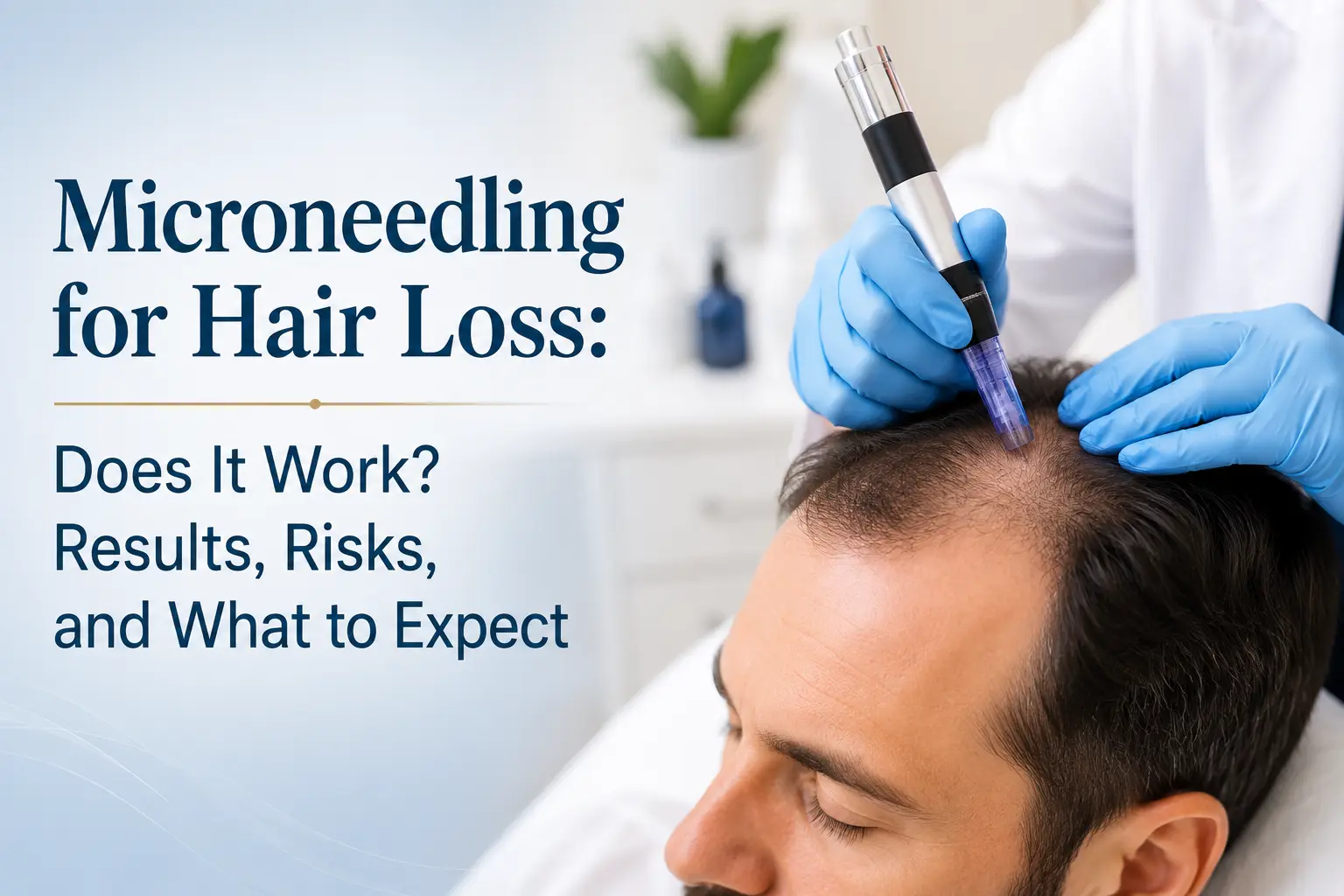
Microneedling for hair loss may support thicker, denser-looking hair in some people, especially those with male or female pattern hair loss.
Current research is most encouraging when scalp microneedling is combined with another hair-growth treatment rather than used alone.
However, microneedling does not work for every type of hair loss.
Hair restoration results depend on what is causing the thinning, whether responsive follicles remain, how the treatment is performed, and which other therapies are used.
A professional hair-loss evaluation can help determine whether microneedling belongs in your treatment plan or whether another approach would better address the underlying cause.
GET HELP RESTORING YOUR HAIR TODAY
Microneedling for Hair Loss at a Glance
| Question | Direct answer |
| Does microneedling help hair loss? | It may support hair growth in people with pattern hair loss, particularly when combined with another treatment. |
| Does microneedling work on its own? | It may provide some benefit, but evidence for microneedling alone is less consistent. |
| How long do results take? | Early changes may appear after about three months, while visible improvements may take three to six months or longer. |
| How many sessions are needed? | Treatment usually involves a series of sessions, but the number and frequency vary. |
| Does it work for every type of hair loss? | No. The cause of the hair loss should be identified before treatment. |
| Is professional treatment different from dermarolling at home? | Yes. Professional treatment provides greater control over depth, sanitation, coverage, and treatment planning. |
| Are the results permanent? | Not necessarily. Ongoing or maintenance treatment may be needed, particularly for progressive pattern hair loss. |
Does Microneedling for Hair Loss Actually Work?
Microneedling may help certain people with androgenetic alopecia, but it should not be viewed as a guaranteed standalone method of regrowing hair.
Research generally shows stronger results when microneedling is combined with topical minoxidil.
A 2025 systematic review and meta-analysis evaluated 12 randomized trials involving 631 people with androgenetic alopecia.
Microneedling combined with minoxidil produced greater improvements in hair count and hair diameter than minoxidil alone.
However, results for hair count varied considerably between the individual studies, showing that protocols and patient responses are not uniform.
These findings suggest that scalp microneedling may be most useful as one part of a broader hair-restoration plan.
How Does Scalp Microneedling Work?
Scalp microneedling uses fine needles to create controlled microchannels in the skin.
These micro-injuries activate a healing response that may support existing hair follicles and change how certain topical treatments interact with the scalp.
Several proposed mechanisms may contribute to its effects.
It Activates the Scalp’s Healing Response
Controlled micro-injuries trigger signaling involved in tissue repair.
This response may influence growth factors, blood-vessel activity, collagen remodeling, and the cellular environment surrounding the follicles.
The goal is not to damage the follicle.
It is to create a controlled response in the scalp while allowing enough time for normal healing between sessions.
It May Affect Hair-Follicle Signaling
Hair follicles move through growth, transition, resting, and shedding phases.
Laboratory research suggests that microneedling may influence signaling pathways associated with the transition into the active growth phase.
It May Increase the Penetration of Topical Treatments
Microneedling temporarily changes the skin barrier by creating small channels in the scalp.
This may allow certain topical products to penetrate differently, which is one reason microneedling is frequently studied with minoxidil.
That does not mean every serum, oil, medication, or cosmetic product is suitable for freshly treated skin.
Applying a product too soon could increase irritation or unintended absorption.
Follow the timing and aftercare instructions provided by the treating professional.
SEE HOW MICRONEEDLING CAN HELP YOU
Which Types of Hair Loss May Respond?
Microneedling has been studied most extensively for androgenetic alopecia, also called male or female pattern hair loss.
Evidence for other causes of hair loss is more limited.
Male Pattern Hair Loss
Male pattern hair loss commonly causes a receding hairline, thinning temples, or loss around the crown.
Microneedling may support miniaturized follicles that still produce hair.
It is generally less likely to restore dense growth in areas that have been completely bald for many years.
Female Pattern Hair Loss
Female pattern hair loss often appears as a widening part or reduced density across the top of the scalp.
The frontal hairline may remain relatively intact even as the hair behind it becomes thinner.
Clinical research involving women has found that microneedling combined with minoxidil may improve hair counts more than minoxidil alone, although additional large and long-term studies are still needed.
Alopecia Areata
Alopecia areata is an autoimmune condition that often causes round or patchy areas of hair loss.
Some small studies have explored microneedling as an additional treatment, but the evidence is less developed than it is for pattern hair loss.
Because alopecia areata involves immune activity, it should be evaluated and managed by a qualified medical professional.
Telogen Effluvium
Telogen effluvium causes increased shedding when a larger-than-usual number of hairs enter the resting phase.
Possible triggers include:
- Illness or surgery
- Hormonal changes
- High levels of physical or emotional stress
- Rapid weight changes
- Nutritional deficiencies
- Certain medications
- Thyroid or other health conditions
Microneedling does not correct these triggers.
Identifying and addressing the reason for the shedding is usually the first priority.
Scarring Alopecia
Scarring alopecia can permanently damage hair follicles and replace them with scar tissue.
It may involve inflammation, burning, tenderness, itching, redness, or smooth areas without visible follicle openings.
Active inflammatory or scarring conditions require medical evaluation.
Microneedling may be inappropriate when active inflammation or permanent follicle destruction is present.
Microneedling for Hair Loss Results: What Can You Expect?
Realistic results may include reduced shedding, thicker existing strands, fine new growth, or an improved appearance of density.
Dramatic restoration of completely bald areas is less likely.
Possible changes include:
- Less visible scalp through thinning areas
- Increased hair shaft diameter
- Fine new hairs around miniaturized follicles
- Improved texture or strength of existing hair
- Greater response to another hair-loss treatment
- Slower progression of visible thinning
Not everyone experiences the same changes.
Some people may notice thicker strands without substantial new growth.
Others may see less shedding while overall density remains similar.
The likelihood of improvement may depend on:
- The cause of the hair loss
- How long the thinning has been present
- Whether active follicles remain
- The severity of follicle miniaturization
- Scalp health
- Treatment consistency
- Other therapies used
- Age and general health
- Individual response
Hair loss is usually easier to address while follicles are weakened but still active.
Microneedling cannot reliably recreate follicles that have been permanently destroyed.
How Long Does Microneedling Take to Regrow Hair?
Some people may notice early changes after approximately three months, but visible improvements usually require three to six months or longer.
Hair grows in cycles, so the appearance of new density does not happen immediately after the scalp heals.
| Approximate timeline | What may happen |
| First 24 to 72 hours | Redness, warmth, tightness, tenderness, or mild swelling may occur |
| First few weeks | The scalp heals; visible hair growth is usually not expected |
| Around 8 to 12 weeks | Early changes in shedding, texture, or fine growth may become noticeable |
| Three to six months | Responsive patients may begin seeing more visible changes in thickness or density |
| Six months and beyond | Progress can be evaluated and the treatment or maintenance plan adjusted |
The pilot study assessed hair-count changes after 12 weeks, while the 2022 female-pattern hair-loss trial continued for 24 weeks.
These are study assessment periods, not guaranteed timelines for individual results.
Microneedling for Hair Loss Before and After: How to Track Progress
Before-and-after photos can help show gradual changes, but only when they are taken consistently.
Differences in lighting, styling, hair length, or camera angle can make hair appear thicker or thinner than it really is.
For more accurate comparisons:
- Use the same room and lighting
- Keep the camera at the same distance and angle
- Position the part in the same place
- Compare dry hair with dry hair
- Avoid using hair fibers or thickening products in one photo but not the other
- Keep hair length reasonably consistent
- Take photos at regular intervals rather than every day
- Record all treatments being used at the same time
A person using minoxidil, PRP, laser therapy, supplements, or another treatment alongside microneedling should not assume that microneedling alone caused the result.
Close-up photographs may also show fine new hairs that are not yet cosmetically significant.
These hairs may need additional time to become longer, thicker terminal strands.
What Happens During Professional Scalp Microneedling?
Professional scalp microneedling generally involves an evaluation, scalp preparation, controlled treatment, and specific aftercare instructions.
Before treatment, the provider should examine the pattern of thinning and the condition of the scalp.
Your health history, current medications, previous hair-loss treatments, and treatment goals may also be reviewed.
The scalp is then cleaned.
Depending on the planned depth and individual sensitivity, a topical numbing product may be used.
During treatment, a microneedling device is moved across the targeted areas in a controlled pattern.
You may feel vibration, pressure, scratching, stinging, or warmth.
Some scalp areas may feel more sensitive than others.
Afterward, the scalp may appear red and feel similar to a mild sunburn. The provider should explain:
- When the scalp can be washed
- Which hair and skin products to avoid
- When topical treatments can be resumed
- How to reduce irritation
- When exercise or heavy sweating can resume
- Which symptoms should be reported
Following the aftercare plan helps protect the scalp while the microchannels close and the skin recovers.
How Often Is Microneedling Performed for Hair Loss?
There is no single microneedling schedule that is right for every person.
Published studies have used weekly sessions, sessions every two weeks, and treatments spaced several weeks apart.
The appropriate frequency depends on:
- Needle depth
- Device type
- Treatment intensity
- Scalp sensitivity
- Healing response
- Cause of hair loss
- Other treatments being used
- Whether persistent irritation develops
A deeper or more intensive session may require a longer recovery period than a superficial treatment.
More frequent treatment does not necessarily mean faster or better hair growth.
Treating the scalp again before it has recovered could cause prolonged redness, inflammation, sensitivity, or damage.
How Many Microneedling Sessions Are Needed for Hair Loss?
Most people need a series of treatments rather than one session.
The total number varies according to the treatment protocol, severity of thinning, healing response, and whether microneedling is combined with another therapy.
Progress may be evaluated using:
- Standardized photographs
- Hair-count measurements
- Hair density
- Hair shaft diameter
- Changes in shedding
- Patient satisfaction
- Scalp tolerance
A treatment plan may be adjusted if the scalp is not recovering properly or if no meaningful improvement is seen after a reasonable assessment period.
Microneedling With Other Hair-Loss Treatments
The evidence for microneedling is strongest when it is used as an additional treatment rather than the only treatment.
Not every combination has the same level of research support.
| Combination | Current evidence | Main consideration |
| Microneedling with minoxidil | Better studied | Product timing and scalp tolerance matter |
| Microneedling with PRP | Promising, but protocols vary | More controlled comparisons are needed |
| Microneedling with laser therapy | Limited combination-specific evidence | The treatments work through different proposed mechanisms |
| Microneedling with regenerative compounds | Product- and protocol-specific | Formulation, sterility, evidence, and timing should be reviewed |
| Microneedling alone | Mixed and less consistent | Results may be more modest than combination treatment |
Microneedling and Minoxidil
Microneedling combined with topical minoxidil has the most supportive clinical research.
The 2025 meta-analysis found that the combination produced greater improvements in hair count and diameter than minoxidil alone.
Adverse events were more frequent with combination treatment, but they were generally described as mild or self-limiting.
Minoxidil should not automatically be applied immediately after a professional microneedling session.
Follow the provider’s instructions regarding when to stop and restart topical products.
Microneedling and PRP
Platelet-rich plasma uses a concentration of platelets obtained from a patient’s own blood.
These platelets contain growth factors involved in tissue signaling and repair.
PRP and microneedling may be used together, but evidence does not show that every patient needs both.
Treatment decisions should consider the hair-loss diagnosis, previous response, scalp health, and cost.
Microneedling and Laser Hair Restoration
Low-level laser therapy uses light energy to support cellular activity within existing hair follicles.
It does not puncture the scalp and generally causes little to no downtime.
Because laser therapy and microneedling work differently, they may be included in the same broader plan when appropriate.
More research is needed to determine which combination schedules work best.
Microneedling and Regenerative Scalp Treatments
Professionally selected regenerative compounds may be used to support scalp and follicle health.
Evidence varies considerably according to the specific formulation and treatment protocol.
Products intended for ordinary use on intact skin should not automatically be applied to freshly microneedled tissue.
Sterility, formulation quality, intended use, and timing all matter when the scalp barrier has been temporarily altered.
Microneedling Side Effects and Risks
The most common microneedling side effects are temporary redness, tenderness, tightness, itching, flaking, and pinpoint bleeding.
More serious reactions are less common but can occur.
Possible side effects include:
- Redness
- Swelling
- Tenderness
- Tightness
- Itching
- Flaking or peeling
- Pinpoint bleeding
- Temporary sensitivity
- Bruising
- Scalp irritation
Less common complications may include:
- Infection
- Prolonged inflammation
- Dark or light pigment changes
- Scarring
- Persistent pain
- Worsening of an existing scalp condition
- A reaction to a product applied after treatment
Who Should Avoid or Delay Scalp Microneedling?
Microneedling may need to be postponed when the scalp is infected, inflamed, injured, or unable to heal normally.
Treatment may not be appropriate for people with:
- Active scalp infections
- Open wounds or sores
- Severe scalp irritation
- Active eczema, psoriasis, or dermatitis in the treatment area
- Certain inflammatory or scarring scalp disorders
- A history of abnormal scarring
- Poor wound healing
- Bleeding or clotting disorders
- Medications that increase bleeding risk
- A weakened immune system
- Unexplained sudden or patchy hair loss
- A recent scalp procedure that has not fully healed
This is not a complete list.
Health history, medications, allergies, and scalp condition should be reviewed before treatment.
At-Home Dermarolling vs. Professional Microneedling
At-home dermarolling is not the same as professional scalp microneedling.
Professional treatment provides more control over depth, sanitation, pressure, treatment coverage, and recovery planning.
| Consideration | At-home dermaroller | Professional microneedling |
| Needle depth | Usually more superficial | Selected according to the treatment plan |
| Pressure | May be inconsistent | Applied in a more controlled manner |
| Scalp diagnosis | Usually absent | Hair-loss pattern and scalp health can be evaluated |
| Sanitation | Depends on user technique | Clinical infection-control procedures are followed |
| Coverage | May be uneven | Thinning areas can be treated systematically |
| Hair breakage | Rollers may catch existing hair | Device and technique may reduce pulling |
| Product timing | Greater risk of inappropriate application | Aftercare can be planned professionally |
| Complication support | Limited | Reactions can be evaluated by the provider |
Home devices should never be shared.
They also need to be cleaned according to the manufacturer’s directions.
Applying too much pressure, reusing damaged or contaminated devices, or treating the scalp too frequently may increase the risk of irritation and infection.
Longer needles may reach living tissue, nerves, and blood vessels, which is one reason professional guidance matters.
Microneedling Compared With Other Hair-Restoration Options
Microneedling is one nonsurgical option among several. The right choice depends on the cause and stage of hair loss, your goals, previous treatments, and whether active follicles remain.
| Treatment | How it may help | Typical downtime | Main consideration |
| Microneedling | Creates controlled microchannels and activates a healing response | Usually mild and temporary | Evidence is strongest as an additional treatment for pattern hair loss |
| Topical treatments | Deliver active ingredients to the scalp | Usually none | Consistent long-term use may be needed |
| PRP | Uses concentrated platelets from the patient’s blood | Mild tenderness or swelling may occur | Response and treatment protocols vary |
| Low-level laser therapy | Uses light energy to support follicle activity | Little to none | Requires consistent use over time |
| Regenerative scalp treatments | Aim to support the scalp environment and existing follicles | Depends on the treatment | Evidence varies by product and protocol |
| Hair transplantation | Moves follicles from a donor area to thinning areas | More involved recovery | Requires surgery and adequate donor hair |
These treatments are not necessarily interchangeable.
Some focus on supporting existing follicles, while hair transplantation physically redistributes follicles from one part of the scalp to another.
How Do You Know Whether You Are a Candidate?
Microneedling may be most appropriate for people with early or moderate thinning who still have active follicles in the affected areas.
Candidacy may depend on:
- Type of hair loss
- Duration of thinning
- Severity of follicle miniaturization
- Scalp condition
- Previous treatments
- General health
- Current medications
- Ability to heal normally
- Willingness to complete multiple sessions
- Expectations about density and maintenance
A hair-loss evaluation may also identify signs that further investigation is needed.
Bloodwork or another medical assessment may be appropriate when hair loss is sudden, diffuse, patchy, painful, or accompanied by other symptoms.
Is Microneedling for Hair Loss Worth It?
Microneedling may be worth considering when you have a responsive type of hair loss, realistic expectations, and a professionally planned treatment approach.
It may be particularly useful for someone with male or female pattern hair loss who:
- Still has active follicles
- Wants a nonsurgical option
- Has not achieved the desired response from one treatment alone
- Is willing to follow a series and maintenance plan
- Understands that results develop gradually
It may be less useful when the hair loss is caused by an untreated hormonal, nutritional, autoimmune, infectious, or inflammatory issue.
Schedule a consultation with Gard Wellness today to see if microneedling can help restore your hair!
Explore Personalized Hair-Restoration Options in Florida
Hair loss does not have one cause or one solution.
Before beginning scalp microneedling, it is important to understand why your hair is thinning and whether the affected follicles are likely to respond.
Gard Wellness Solutions offers personalized, nonsurgical hair-restoration options in Florida.
Its hair-restoration protocols may incorporate microneedling, PRP, laser hair restoration, regenerative compounds, or other treatments selected according to the patient’s needs.
A personalized evaluation can help determine which options align with your hair-loss pattern, scalp health, treatment goals, and overall health.
FAQs: Microneedling for Hair Loss
Does microneedling regrow hair?
Microneedling may support hair growth in some people with androgenetic alopecia, especially when combined with a treatment such as topical minoxidil. It does not work for every cause of hair loss and cannot reliably restore permanently destroyed follicles.
How long does microneedling take to work for hair loss?
Early changes may appear after approximately three months, but visible improvements in thickness or density often require three to six months or longer. Results depend on the hair-growth cycle, treatment plan, and underlying cause of thinning.
How many microneedling sessions are needed for hair loss?
Many people require several sessions over a period of months. The total number depends on the severity of hair loss, protocol, treatment response, and whether maintenance sessions are recommended.
Does microneedling work without minoxidil?
Microneedling may provide some benefit by itself, but evidence for standalone treatment is less consistent. Combination treatment with minoxidil has been studied more extensively.
Does microneedling work for a receding hairline?
It may support miniaturized follicles along a thinning hairline if those follicles remain active. Areas that are smooth or have been bald for many years may be less responsive.
Can women use microneedling for thinning hair?
Yes. Microneedling has been studied in women with female pattern hair loss. Women with sudden or diffuse shedding should also be evaluated for hormonal, thyroid, nutritional, medication-related, and stress-related causes.
Can microneedling help alopecia areata?
Limited research has explored microneedling for alopecia areata, but this autoimmune condition requires proper diagnosis and medical management. Microneedling should not replace evaluation of the underlying immune activity.