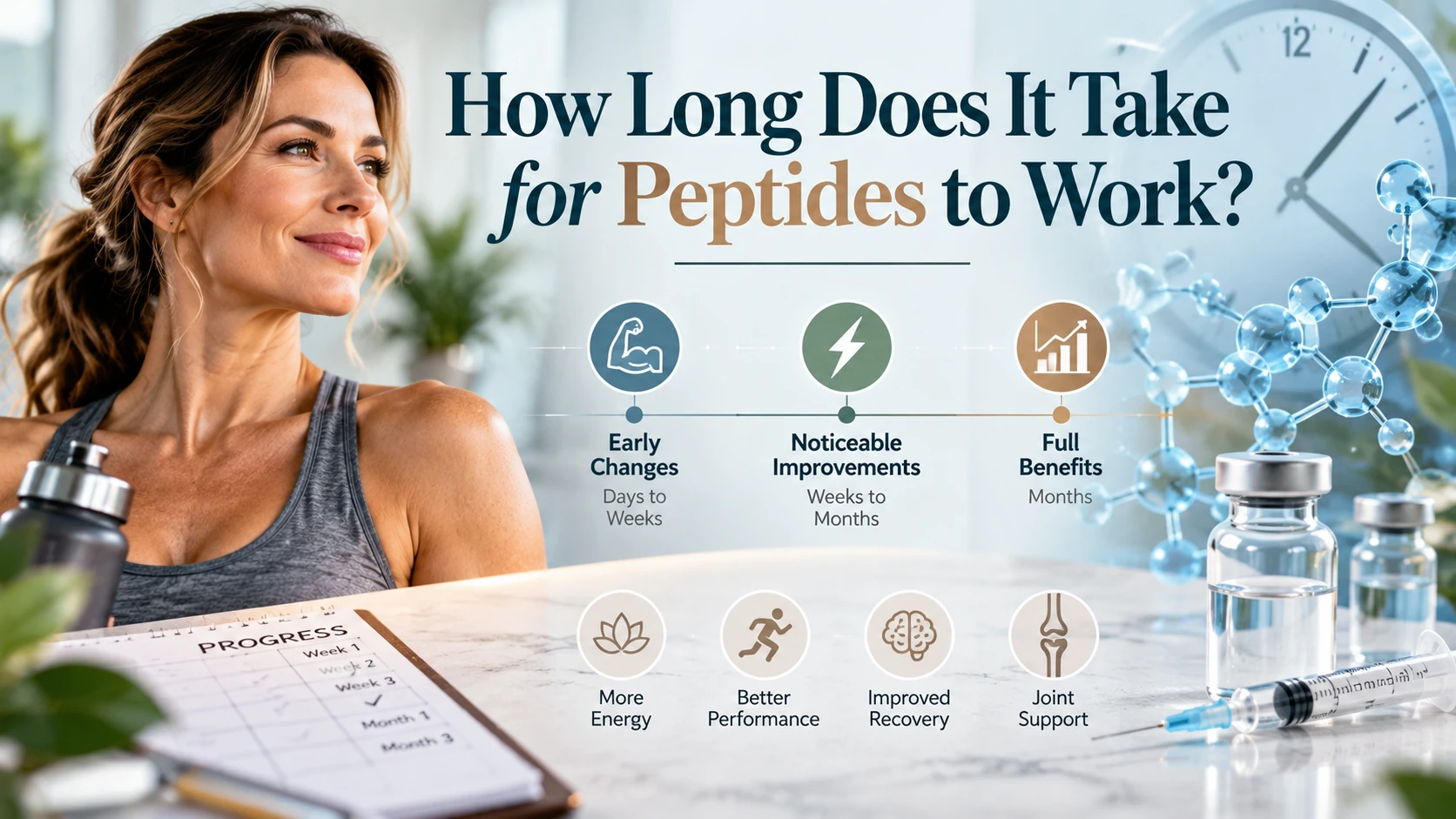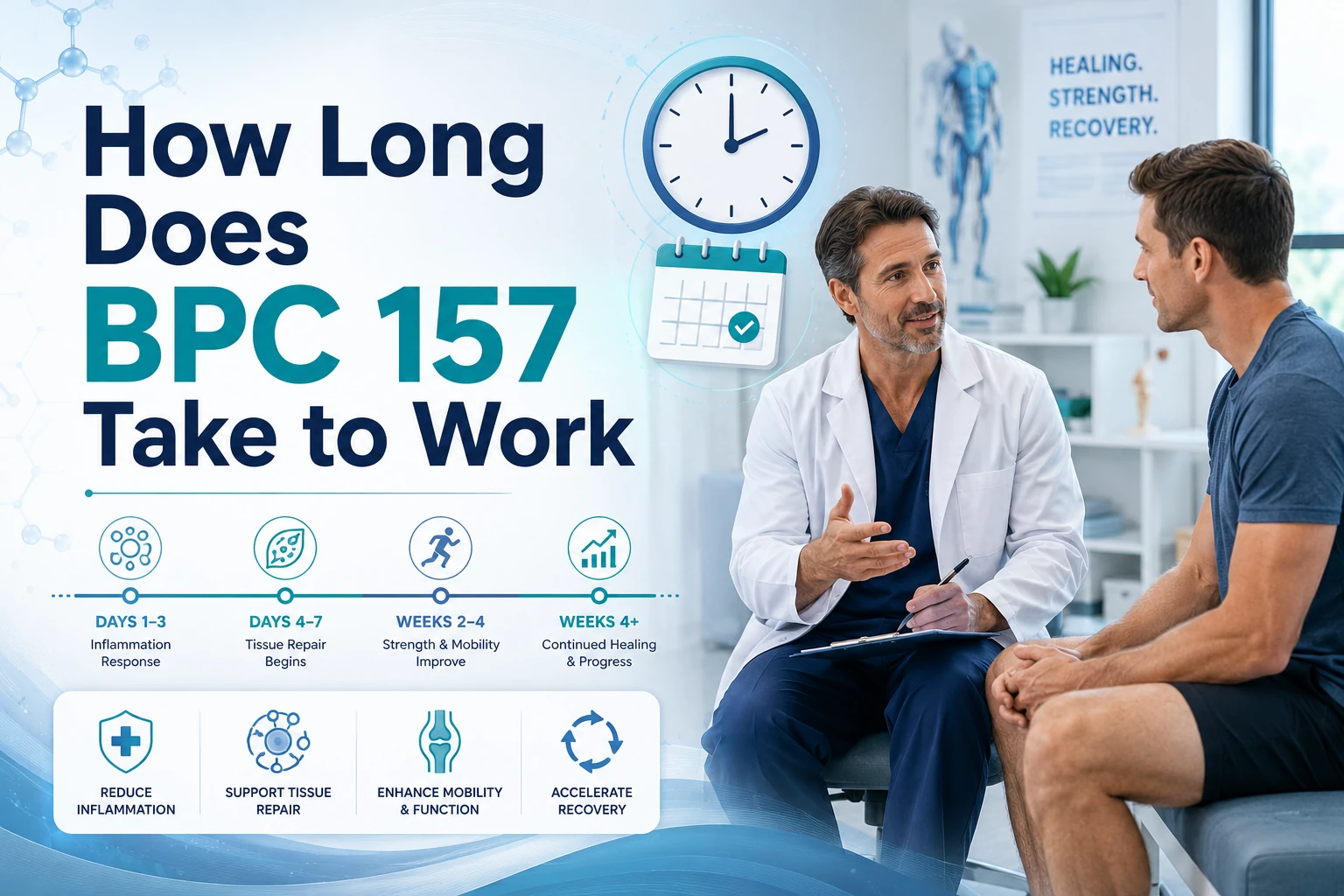
Most people using BPC-157 notice small changes, like less soreness or better sleep, within one to two weeks.
More noticeable healing, such as improved range of motion or reduced swelling, typically shows up between weeks three and eight.
Full recovery for bigger injuries can take up to twelve weeks, and human research on the exact timeline is still limited.
If you just started BPC-157, you’re probably checking in on your body every few days, wondering when you’ll actually feel a difference.
How long does BPC-157 take to work depends on what you’re using it for, how you’re taking it, and what kind of tissue your body is trying to repair.
Below is a realistic week-by-week timeline, what the research actually supports, and how to tell your body is responding.
SEE IF BPC-157 IS RIGHT FOR YOU
How Long Does BPC-157 Take to Work?
Most people using BPC-157 notice subtle changes, like less soreness at the injury site or improved digestion, within the first one to two weeks.
More noticeable healing, like better range of motion or less swelling, tends to show up between weeks three and eight.
For larger injuries or chronic conditions, full recovery can take eight to twelve weeks or longer.
These timelines come from a mix of clinical observation and patient reports, not a single large study.
Every person’s biology, injury type, and dosing routine is different, so your own timeline could land earlier or later than this general pattern.
The most important thing to keep in mind is that BPC-157 works gradually.
It’s not designed to produce an instant effect the way a painkiller does.
It supports your body’s own repair process, so results tend to build over weeks rather than appear overnight.
What Is BPC-157 and Why Does Timing Vary So Much?
BPC-157 is a synthetic peptide made up of 15 amino acids, based on a protein sequence found naturally in human gastric juice.
Early research suggests BPC-157 may support blood vessel formation and calm inflammation, which is part of why it’s used for joint, tendon, and gut recovery.
You can read more about BPC-157’s broader role in tissue repair and inflammation if you want the full picture beyond timing.
Timing varies from person to person for a few reasons.
Fresh injuries respond differently than injuries you’ve been dealing with for months or years, since the body’s natural repair machinery is already active in a fresh injury.
Age, overall health, dosing consistency, and whether you’re using an injectable or oral form all play a role too.
It also helps to understand that your body already heals in stages, whether or not you’re using a peptide.
According to the phases of wound healing, the first stage (inflammation) usually runs for about a week, the next stage (tissue building) plays out over roughly two weeks, and full remodeling can continue for months afterward.
BPC-157 is thought to work within these same stages rather than skip past them, which is why results build gradually instead of appearing all at once.
What Does the Research Actually Say About BPC-157’s Timeline?
The honest answer is that human research on BPC-157’s exact timeline is still thin.
Most of what’s known comes from animal studies and a handful of small human pilot studies, not large controlled trials, so any specific week-by-week claim is really an educated estimate rather than an established medical fact.
In one rat study on spinal cord injury, researchers observed measurable microscopic improvement by day 7, with muscle spasticity fully resolved by day 15 in the treated group, while untreated animals showed continued symptoms for months.
That’s animal data, so it doesn’t map directly onto a human injury timeline, but it does show the biological process can move relatively fast at a cellular level.
On the human side, one of the few published pilot studies followed 12 women with interstitial cystitis who received a single BPC-157 bladder injection.
At the six-week follow-up, 10 of the 12 women reported complete resolution of their symptoms, with no adverse events reported.
That’s a promising result, but it’s also a small, uncontrolled study, and it’s not the kind of data that lets anyone predict exactly how fast your specific injury will respond.
Across all published human research to date, fewer than 30 people have been formally studied, which is why timelines you see online are largely based on clinical experience and patient reports rather than controlled trial data.
The BPC-157 Recovery Timeline, Week by Week
With those research limits in mind, here’s the general pattern that clinicians and patients most commonly report.
Think of this as a rough guide, not a guarantee.
Weeks 1 to 2: Early Signs
This is usually when people first notice something is different.
Common early signs include less soreness at rest, mild improvement in swelling, and, for people using BPC-157 for gut issues, less bloating or discomfort after meals.
These early changes tend to be subtle and easy to miss if you’re not paying attention.
Weeks 3 to 4: Building Momentum
By this point, many people notice more functional improvements, like being able to move a joint through a fuller range of motion or handle light activity without the same level of discomfort.
This is often when the difference starts to feel real instead of just hopeful.
Weeks 5 to 8: Deeper Tissue Repair
This stretch tends to bring the most meaningful changes for tendon, ligament, and joint injuries, since this is roughly when tissue starts regaining real load-bearing strength.
Chronic, long-standing issues often need this full window before showing consistent improvement.
Weeks 8 to 12: Plateau or Full Recovery
By week 8 to 12, most people have either reached a fairly stable, improved state or hit a plateau.
If you’re still seeing steady week-over-week progress, that’s a good sign.
If nothing has changed by this point, it’s worth reassessing your dosing, delivery method, or whether BPC-157 is the right fit for what you’re treating.
Does BPC-157 Work Faster for Some Uses Than Others?
Yes.
BPC-157 tends to show effects fastest for gut-related symptoms and general inflammation, often within one to two weeks, while joint and tendon injuries usually take three to six weeks to show real change.
Slower-responding uses like hair growth can take two to three months before results become visible.
The difference comes down to how much tissue needs to rebuild and how much blood flow that area naturally gets.
Gut lining cells turn over quickly on their own, so support from BPC-157 can show up sooner.
Tendons and ligaments have much lower blood flow, which is part of why they’re notoriously slow to heal even without any injury at all, so it makes sense that BPC-157 needs more time to make a visible difference there.
Fresh, acute injuries also tend to respond faster than chronic ones.
A tendon strain from three weeks ago is still in an active repair phase, while pain you’ve managed for two years may need extra time before the tissue starts responding differently.
What Affects How Quickly BPC-157 Works?
How fast BPC-157 works depends on the delivery method, how consistently it’s used, your age and baseline health, and whether the issue you’re treating is fresh or long-standing.
Injectable BPC-157 generally reaches the bloodstream more directly than oral capsules, which can affect how soon effects show up.
Injectable forms bypass digestion entirely, delivering the peptide close to the site that needs it or into circulation more broadly.
Oral forms have to survive the digestive tract first.
BPC-157 is unusually stable in gastric juice, which is part of why it’s studied for gut-related use, but less is known about how much of an oral dose actually reaches the bloodstream for systemic issues like joint or tendon repair.
Consistency matters just as much as the form you choose.
Skipping doses or starting and stopping resets some of the progress your body has made.
In our experience working with patients recovering from joint and tendon injuries, staying on a steady, provider-guided protocol tends to matter as much as which delivery method someone picks.
Age and general health also play a role, since the body’s natural production of the growth factors involved in tissue repair tends to decline over time.
A healthy 30-year-old and a 60-year-old managing other health conditions may see different timelines even with the same injury and the same protocol.
How Do You Know If BPC-157 Is Working?
Signs BPC-157 is working usually include less pain at rest, reduced swelling, better range of motion, improved digestion if that’s your goal, and less fatigue after activity.
These changes tend to build gradually rather than show up all at once, so tracking symptoms week to week is more useful than judging day to day.
A simple weekly note, even just a quick rating of pain, swelling, and mobility, can help you spot a trend that’s easy to miss otherwise.
Small, steady improvement over several weeks is usually a better sign than a single dramatic change.
If there’s been no noticeable change by week six to eight of consistent use, that’s a reasonable point to check in with a provider.
It could mean the dose needs adjusting, the delivery method isn’t the right fit, or something else is contributing to the issue.
Is It Safe to Keep Using BPC-157 While You Wait for Results?
BPC-157 is not currently approved by the FDA for any medical use, and its regulatory status for compounding has continued to shift throughout 2026 as federal agencies review it.
It’s also on the World Anti-Doping Agency’s banned substance list, so it isn’t an option for competitive athletes subject to WADA testing.
The FDA’s review of BPC-157’s compounding status is still ongoing, which means access and sourcing can change.
Because of that uncertainty, and because dosing errors are easy to make without guidance, it’s worth getting a baseline health evaluation and ongoing monitoring from a provider rather than sourcing and dosing it on your own.
How Gard Wellness Solutions Supports Your BPC-157 Recovery
Waiting to see if a treatment is working is easier when someone is actually tracking your progress with you.
Our pain and inflammation management program pairs peptide therapy, including BPC-157, with the kind of follow-up that catches small changes early instead of leaving you guessing at week six with no clear answer.
We start with a full evaluation to understand what you’re dealing with, whether that’s a stubborn tendon injury, chronic joint pain, or something else entirely.
From there, our pain and inflammation management program is built around your specific timeline, with regular check-ins so your protocol can be adjusted if week 4 or week 8 doesn’t look the way it should.
Booking a visit with our team is the fastest way to get personalized dosing guidance and a realistic sense of what timeline to expect for your specific situation.
FAQs: How Long Does BPC-157 Take to Work
How long does BPC-157 take to work for an injury?
Most people notice small changes, like less soreness, within one to two weeks. More noticeable healing, such as better range of motion or reduced swelling, usually shows up between weeks three and eight, with full recovery for larger injuries sometimes taking up to twelve weeks.
How quickly does BPC-157 work compared to the body’s natural healing?
BPC-157 doesn’t replace your body’s own healing process, it works alongside it. Research suggests it may support the same inflammatory, tissue-building, and remodeling phases your body already goes through, so it can shorten the timeline rather than create an entirely separate one.
Does BPC-157 work faster as an injection or taken orally?
Injectable BPC-157 generally reaches the bloodstream more directly and consistently, which is why it’s often used for joint, tendon, and systemic recovery. Oral BPC-157 is commonly used for gut-related concerns since it interacts with the digestive lining directly, though less is known about how much actually gets absorbed.
Can BPC-157 stop working or plateau?
Yes. Many people notice steady improvement through the first several weeks, then a plateau once the tissue has mostly healed. If there’s been no change at all by week six to eight, it’s worth checking in with a provider about dosing or whether it’s the right approach.
Is BPC-157 legal and FDA-approved?
BPC-157 is not approved by the FDA for any medical use, and its regulatory status for compounding has continued to shift through 2026. It’s also banned by the World Anti-Doping Agency, so it isn’t an option for competitive athletes subject to WADA testing.
How long should you use BPC-157 before deciding it isn’t working?
Most providers suggest giving it at least six to eight weeks of consistent use before drawing conclusions, since meaningful tissue repair takes time. If there’s truly no change by then, that’s a reasonable point to reassess the plan with a provider.