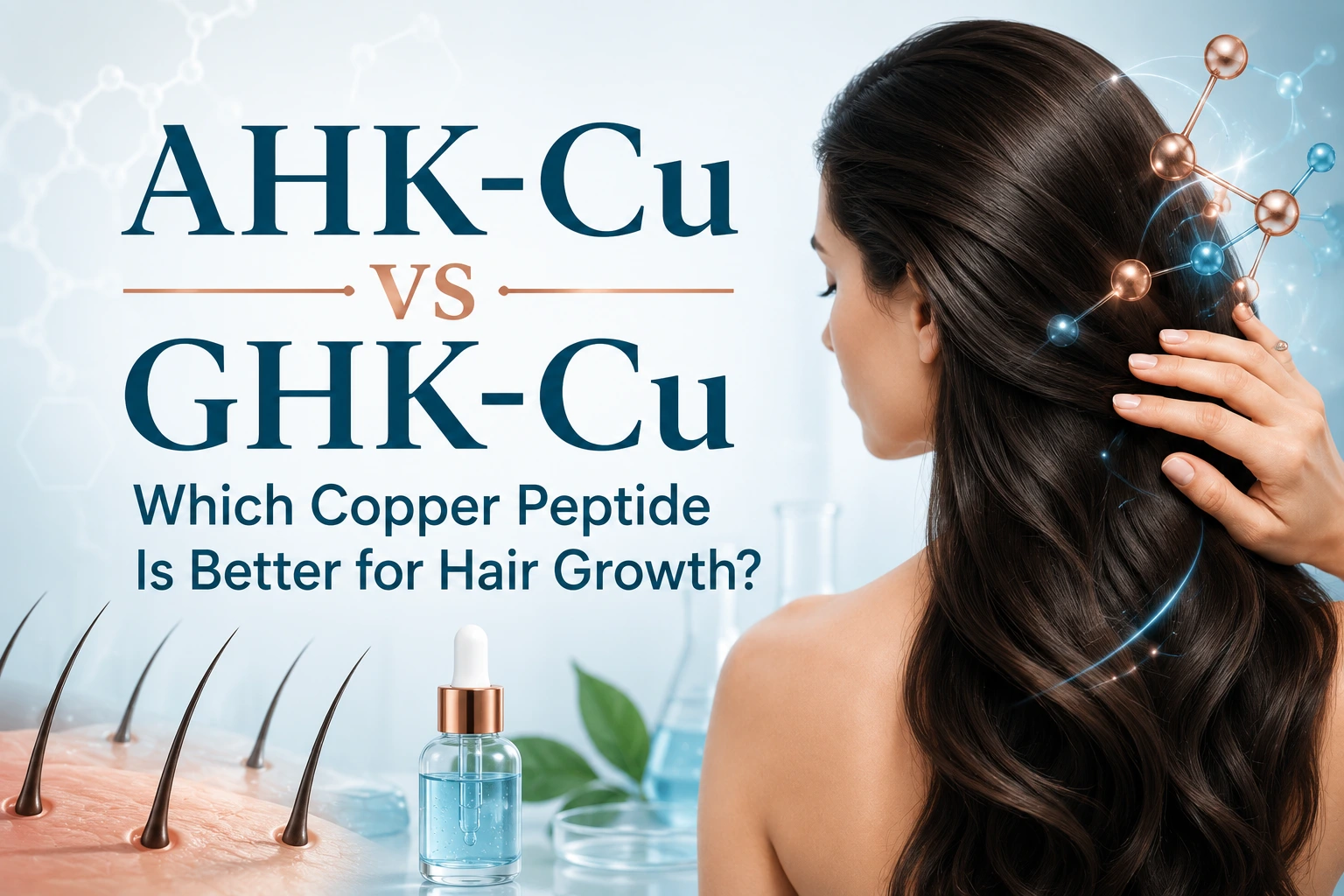
AHK-Cu and GHK-Cu are closely related copper peptide therapies, but they have different research strengths.
AHK-Cu has been studied more directly in relation to human hair follicles and dermal papilla cells.
GHK-Cu has a broader research history involving collagen, tissue repair, inflammation, antioxidant activity, and skin remodeling.
Neither peptide has been proven superior in head-to-head human hair-growth trials.
When comparing AHK-Cu vs GHK-Cu, the better option may depend on whether the goal is targeted follicle support, broader scalp support, skin rejuvenation, or a combination of concerns.
Key Takeaways
- AHK-Cu and GHK-Cu differ by one amino acid.
- AHK-Cu has more direct laboratory research involving isolated human hair follicles.
- GHK-Cu has a broader body of research related to skin, collagen, inflammation, and tissue repair.
- Neither copper peptide has enough comparative human evidence to be called the best choice for every type of hair loss.
- The cause of thinning may matter more than selecting one peptide over the other.
SEE WHICH COPPER PEPTIDE IS RIGHT FOR YOU
AHK-Cu vs GHK-Cu at a Glance
| Feature | AHK-Cu | GHK-Cu |
| Full name | Alanine-histidine-lysine copper | Glycine-histidine-lysine copper |
| Amino acid sequence | Alanine–Histidine–Lysine | Glycine–Histidine–Lysine |
| Common cosmetic name | Copper Tripeptide-3 | Copper Tripeptide-1 |
| Main research focus | Hair follicles and dermal papilla cells | Skin repair, collagen, inflammation, and tissue remodeling |
| Hair-related evidence | Direct laboratory and isolated human follicle research | Broader supportive and preclinical research |
| Skin-related evidence | More limited | More extensive |
| Frequently discussed for | Follicle-focused support | Scalp, skin, and tissue support |
| Main limitation | Limited human clinical research | Limited direct human hair-regrowth evidence |
| Proven superior for hair growth? | No | No |
The simplest difference is that AHK-Cu has been studied more directly in relation to follicle activity, while GHK-Cu has been studied more broadly in relation to the tissue surrounding the follicle.
That does not mean AHK-Cu always produces better hair restoration or that GHK-Cu is only useful for skin.
Their potential effects overlap, and the clinical evidence for both remains limited.
What Are Copper Peptides?
Copper peptides are short chains of amino acids that bind to copper ions.
Peptides can act as signaling molecules, helping cells respond to processes such as tissue repair, inflammation, oxidative stress, and cellular turnover.
Copper also contributes to enzymes involved in connective tissue formation, antioxidant protection, pigmentation, and tissue maintenance.
Binding copper to a peptide may influence how it is transported and used within tissues.
Copper peptides are often discussed in hair-restoration settings because of their possible effects on:
- Dermal papilla cells
- Hair-follicle signaling
- Scalp tissue quality
- Collagen production
- Extracellular matrix organization
- Local inflammation
- Oxidative stress
- Blood-vessel signaling
These biological processes may be relevant to healthy hair growth.
However, a promising mechanism does not prove that a peptide will reverse hair loss in every patient.
What Is AHK-Cu?
AHK-Cu stands for alanine-histidine-lysine copper.
It is a tripeptide containing alanine, histidine, and lysine bound to copper.
AHK-Cu is often listed as Copper Tripeptide-3 in cosmetic and ingredient discussions.
It has gained attention primarily because of research involving human hair follicles and dermal papilla cells.
Dermal papilla cells are located near the base of the follicle.
They help regulate follicle development, cycling, size, and hair-shaft production.
Changes in these cells may contribute to the progressive miniaturization seen in some forms of hair loss.
What Does the Research Say About AHK-Cu for Hair Growth?
A frequently cited 2007 laboratory study examined the effects of AHK-Cu on isolated human hair follicles and cultured dermal papilla cells.
Researchers reported that AHK-Cu:
- Encouraged the elongation of isolated human hair follicles
- Increased dermal papilla cell proliferation
- Influenced proteins associated with cell survival and programmed cell death
These findings suggest that AHK-Cu may affect biological processes involved in follicle activity.
However, the study did not follow people applying or receiving AHK-Cu over several months.
The follicles were examined outside the body, and the cells were grown under controlled laboratory conditions.
The study therefore supports a potential mechanism.
It does not establish how much hair a person may regrow, which conditions may respond, what concentration works best, or whether AHK-Cu outperforms other hair-loss treatments.
What Is GHK-Cu?
GHK-Cu stands for glycine-histidine-lysine copper.
It contains glycine, histidine, and lysine bound to copper.
GHK is a naturally occurring peptide found in human plasma and other body fluids.
Researchers have studied GHK and GHK-Cu for decades in connection with tissue repair, wound healing, collagen regulation, antioxidant activity, and inflammation.
GHK-Cu has been associated in laboratory, animal, and limited human research with processes involving:
- Collagen and elastin production
- Extracellular matrix remodeling
- Fibroblast activity
- Glycosaminoglycan production
- Antioxidant protection
- Inflammatory signaling
- Tissue recovery
- Blood-vessel development
These processes may help support the scalp environment surrounding active follicles.
However, the evidence for GHK-Cu and general skin or tissue repair is stronger than the direct human evidence showing that it consistently regrows scalp hair.
What Is the Difference Between AHK-Cu and GHK-Cu?
AHK-Cu and GHK-Cu differ by only one amino acid.
- AHK-Cu begins with alanine: Alanine–Histidine–Lysine
- GHK-Cu begins with glycine: Glycine–Histidine–Lysine
Both peptides bind copper, but a small structural difference can influence how a peptide interacts with cells, proteins, and biological pathways.
Copper Tripeptide-1 vs Copper Tripeptide-3
GHK-Cu is commonly identified as Copper Tripeptide-1, while AHK-Cu is commonly identified as Copper Tripeptide-3.
These names may appear on ingredient lists, product labels, or technical documents.
They do not indicate that one ingredient is stronger or more advanced than the other.
They identify two different copper-binding peptide complexes.
AHK-Cu Has More Follicle-Focused Research
The best-known AHK-Cu study examined isolated human follicles and dermal papilla cells.
This gives AHK-Cu a more direct connection to follicle-focused laboratory research.
However, the overall research base is small.
Limited laboratory findings cannot confirm that AHK-Cu will produce meaningful hair regrowth in people with different causes and stages of thinning.
GHK-Cu Has Broader Tissue Research
GHK-Cu has been studied across a wider range of skin, wound-healing, tissue-remodeling, and inflammatory settings.
This broader research may be relevant when scalp inflammation, age-related skin changes, oxidative stress, or poor tissue quality are affecting the environment around the follicles.
Broader research does not automatically make GHK-Cu the better hair-growth peptide.
Much of its evidence is indirect, preclinical, or focused on tissues other than scalp hair.
AHK-Cu vs GHK-Cu: How Strong Is the Evidence?
| Research Question | AHK-Cu | GHK-Cu |
| Laboratory cell research | Available | Available |
| Isolated human follicle research | Available | Limited |
| Dermal papilla cell research | Available | Limited but biologically relevant research exists |
| Animal hair-growth research | Limited | Available for GHK-Cu or related copper complexes |
| Controlled human hair-loss trials | Insufficient | Insufficient |
| Direct head-to-head human trials | None established | None established |
| Broader skin and tissue research | Limited | More extensive |
| Proven to regrow hair consistently | No | No |
This distinction is important.
Laboratory, animal, and isolated-follicle findings can explain why researchers are interested in copper peptides, but they cannot predict exactly how a person will respond.
Human hair loss is influenced by genetics, hormones, health conditions, medications, nutrition, age, and scalp health.
A peptide may affect one biological pathway without addressing the main cause of thinning.
AHK-Cu vs GHK-Cu for Hair Growth
AHK-Cu has the advantage when looking specifically at direct laboratory research involving isolated human follicles.
GHK-Cu has the advantage when considering the overall amount of research involving tissue repair, collagen, inflammation, and skin health.
Neither can currently be declared the universal winner.
When AHK-Cu May Be Considered
AHK-Cu may receive greater attention when the main goal is supporting processes related to dermal papilla cells and viable hair follicles.
Its laboratory findings suggest potential effects on:
- Dermal papilla cell activity
- Follicle elongation
- Cell-survival pathways
- Signaling around active follicles
The condition of the follicle matters.
A peptide should not be expected to recreate follicles that have been permanently destroyed or replaced by scar tissue.
When GHK-Cu May Be Considered
GHK-Cu may receive greater attention when the goal includes broader support for the scalp tissue surrounding the follicles.
Its researched properties may be relevant to:
- Collagen organization
- Extracellular matrix remodeling
- Tissue repair
- Inflammatory balance
- Antioxidant activity
- Fibroblast function
- Blood-vessel signaling
This broader activity may support a healthier scalp environment, but direct evidence that GHK-Cu alone produces substantial human hair regrowth remains limited.
Which Copper Peptide Should You Choose?
AHK-Cu may be the more relevant peptide to discuss when the primary interest is follicle-focused laboratory research.
GHK-Cu may be the more relevant option when the goal includes broader skin, scalp, collagen, or tissue support.
A simple way to compare them is:
AHK-Cu has been studied more directly in relation to hair follicles.
GHK-Cu has been studied more extensively in relation to skin and tissue repair.
The choice should not be based on the peptide name alone.
It should also consider:
- The cause of hair loss
- Whether viable follicles remain
- Scalp inflammation or irritation
- The delivery method
- Other treatments being used
- Product quality and stability
- Individual skin sensitivity
Some people may need one peptide, a combination approach, or a treatment plan that does not involve copper peptides at all.
Is AHK-Cu or GHK-Cu Better for Skin?
GHK-Cu has the stronger and broader research base for skin.
Research has connected GHK-Cu with collagen and elastin regulation, extracellular matrix remodeling, fibroblast activity, antioxidant protection, inflammation, and wound recovery.
AHK-Cu may also appear in skin and scalp formulations, but its best-known published research is more closely connected to follicle biology.
For someone mainly interested in skin tightening, tissue repair, or age-related skin changes, GHK-Cu is generally the more extensively researched of the two.
For someone focused on hair follicles, AHK-Cu may be more directly relevant, although human evidence remains limited.
Can You Use AHK-Cu and GHK-Cu Together?
AHK-Cu and GHK-Cu may appear together in some hair or scalp formulations.
The theory is that AHK-Cu may provide more follicle-focused activity while GHK-Cu supports the surrounding scalp tissue.
However, strong human research has not established that combining the two produces better results than using either peptide alone.
Published research has not adequately compared:
- AHK-Cu alone
- GHK-Cu alone
- A combination of both peptides
- A placebo
- Established hair-loss treatments
Using more active ingredients does not automatically produce better results.
Stability, concentration, delivery, skin tolerance, and formulation quality all matter.
Combining several scalp products may also cause irritation or make it difficult to determine which ingredient is responsible for a reaction.
Does the Delivery Method Matter?
Yes.
The way a copper peptide is formulated and delivered may affect how well it reaches the intended tissue.
Copper peptides may appear in:
- Topical scalp serums
- Shampoos or conditioners
- Cosmetic skin products
- Compounded formulations
- Provider-directed treatment protocols
These delivery methods are not equivalent.
The skin forms a protective barrier.
A product’s concentration, pH, stability, storage conditions, and supporting ingredients may affect how much active peptide reaches the scalp or follicle.
The presence of AHK-Cu or GHK-Cu on an ingredient label does not prove that the finished product delivers an effective amount to the intended tissue.
How Long Do Copper Peptides Take to Work for Hair?
There is no established clinical timeline for AHK-Cu or GHK-Cu hair-growth results.
Hair grows in cycles, so meaningful changes are unlikely to be measured after only a few days.
Depending on the cause of thinning and the complete treatment plan, changes in shedding, scalp condition, density, or visible growth may take several months to assess.
Progress should be evaluated using consistent methods, such as:
- Photos taken under the same lighting
- Measurements of part width
- Changes in shedding
- Hair-density assessments
- Examination of miniaturized hairs
- Scalp-health changes
Continuing hair loss should not be ignored while waiting for a peptide to work.
Persistent or rapidly progressing thinning may require evaluation for an underlying medical, nutritional, hormonal, or inflammatory cause.
Do Copper Peptides Block DHT?
AHK-Cu and GHK-Cu are not established DHT blockers.
Dihydrotestosterone, or DHT, contributes to androgenetic alopecia in genetically susceptible men and women.
Copper peptides are generally discussed for their possible effects on follicle signaling, tissue support, inflammation, and repair.
They have not been shown to reliably reduce DHT production or block androgen receptors in the same way as treatments specifically intended to address androgen-related hair loss.
Someone with male or female pattern hair loss may need an approach that addresses androgen sensitivity in addition to supporting the scalp and follicles.
Can Copper Peptides Be Used With Minoxidil?
Copper peptides and minoxidil work through different proposed mechanisms, so they may sometimes be included in the same broader hair-restoration plan.
Minoxidil has controlled human clinical evidence supporting its use for androgenetic alopecia.
The evidence for AHK-Cu and GHK-Cu is earlier and less conclusive.
That does not mean every copper peptide product should automatically be layered with minoxidil.
Combining topical products may affect:
- Scalp irritation
- Product absorption
- Formulation stability
- Application timing
- Consistency with treatment
Professional guidance can help determine whether products should be used together, applied at different times, or avoided based on the condition of the scalp.
Copper Peptides May Not Address the Cause of Hair Loss
Hair loss is a symptom rather than a single condition.
Possible causes and contributing factors include:
- Genetic sensitivity to androgens
- Hormonal changes
- Menopause or perimenopause
- Thyroid dysfunction
- Low iron or other nutrient deficiencies
- Illness or surgery
- Physical or emotional stress
- Rapid weight changes
- Certain medications
- Autoimmune conditions
- Scalp inflammation
- Traction from hairstyles
- Scarring disorders
AHK-Cu or GHK-Cu may support certain biological processes around an active follicle, but neither peptide can be expected to correct every possible cause.
The pattern of hair loss can provide useful clues.
A widening part may have a different cause than sudden diffuse shedding, smooth bald patches, a receding hairline, scalp pain, or visible scarring.
Identifying the likely cause can help determine whether copper peptides make sense as part of the plan or whether another health issue should be addressed first.
How a Hair-Loss Evaluation Can Help
A professional hair-loss evaluation looks beyond the question of AHK-Cu vs GHK-Cu.
The evaluation may consider:
- When the hair loss began
- Whether shedding was sudden or gradual
- The pattern and location of thinning
- Family history
- Hormonal symptoms
- Recent illness, stress, surgery, or weight changes
- Medications and supplements
- Nutrition
- Scalp irritation or inflammation
- Whether follicles appear active, miniaturized, or scarred
The goal is not simply to select a popular peptide.
It is to identify what may be interfering with healthy growth and create a plan that fits the individual.
Gard Wellness Solutions provides personalized hair-restoration services in Florida.
An evaluation can help identify possible causes of thinning and determine whether copper peptides or other treatment approaches may fit into a broader care plan.
The Bottom Line on AHK-Cu vs GHK-Cu
AHK-Cu and GHK-Cu are closely related copper peptides with different research strengths.
AHK-Cu has more direct follicle-focused laboratory evidence.
It has been shown to influence isolated human hair-follicle elongation and dermal papilla cell activity under controlled research conditions.
GHK-Cu has a broader research history involving collagen, tissue repair, extracellular matrix remodeling, inflammation, antioxidant activity, and skin health.
These effects may help support the environment surrounding active follicles.
Neither peptide has enough comparative human research to be declared the best option for everyone.
The cause of hair loss, condition of the follicles, scalp health, delivery method, and complete treatment plan may matter more than choosing one peptide based on its name alone.
FAQs: AHK-Cu vs GHK-Cu
Is AHK-Cu the same as GHK-Cu?
No. Both are copper-binding tripeptides, but they have different amino-acid sequences. AHK-Cu contains alanine, histidine, and lysine. GHK-Cu contains glycine, histidine, and lysine.
Is AHK-Cu better than GHK-Cu for hair?
AHK-Cu has more direct laboratory research involving isolated human follicles and dermal papilla cells. However, human trials have not shown that it produces better hair-growth results than GHK-Cu.
Can you combine AHK-Cu and GHK-Cu?
The peptides may appear together in some formulations, but strong human studies have not shown that combining them works better than using either peptide alone.
How long does AHK-Cu take to work?
There is no established clinical timeline. Hair-cycle changes take time, and visible improvement may depend on the cause of thinning, delivery method, scalp condition, and other treatments being used.
Do AHK-Cu and GHK-Cu replace minoxidil?
No. Copper peptides have less direct human clinical evidence for hair growth than minoxidil. They may be considered supportive options, but they should not automatically be treated as replacements.
Do copper peptides block DHT?
No reliable human evidence shows that AHK-Cu or GHK-Cu directly blocks DHT. Someone with androgen-related hair loss may need a treatment approach that addresses androgen sensitivity.
Can GHK-Cu Injections Help Hair Growth?
GHK-Cu injections may support tissue repair, collagen production, inflammation balance, and the scalp environment, but strong human research showing that they consistently regrow hair is limited. They should not be considered a proven treatment for every type of hair loss, and any injectable protocol should be discussed with a qualified healthcare provider.