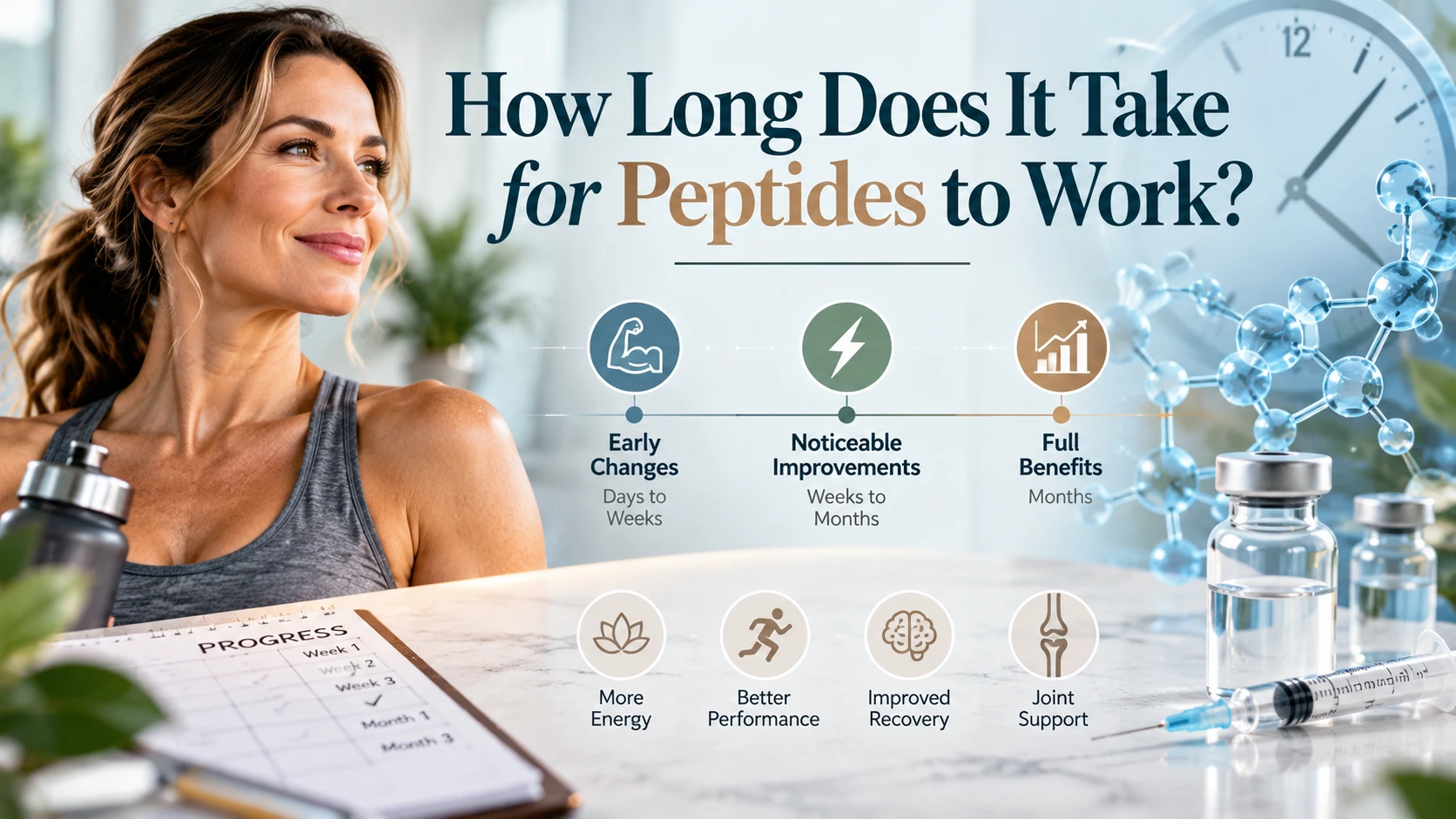
Most people notice the first signs of peptide therapy working within 1 to 2 weeks, with more visible changes building by weeks 6 to 12.
Full results typically take 3 to 6 months of consistent use, since peptides create change through gradual signaling rather than an instant switch.
The exact timeline depends on which peptide you’re using, your dosing consistency, and your own biology.
If you just started peptide therapy, or you’re still deciding whether to try it, you’ve probably asked the same question most people ask first: how long does it take for peptides to work?
Or put more simply, how long for peptides to work?
The honest answer is that it depends on a few things, including which peptide you’re using and how consistent you are with your protocol.
Still, there’s a general pattern most people follow, and knowing it now can help you set realistic expectations instead of guessing.
SEE IF PEPTIDE THERAPY IS RIGHT FOR YOU
How Long Does It Take for Peptides to Work?
Most people notice the first subtle changes, like steadier energy or better sleep, within 1 to 2 weeks of starting peptide therapy.
More visible results, such as reduced soreness or early body composition changes, usually appear between weeks 6 and 12.
Full results typically take 3 to 6 months, depending on the peptide and your personal goals.
This range holds true across most peptide types, but it’s an average, not a guarantee.
Some peptides, like those used for sleep or recovery, tend to work faster.
Others, like peptides used for weight management, build gradually over several months as your body adjusts to new signaling patterns.
Your provider should set expectations specific to the peptide and dose you’re using.
A general timeline is useful for planning, but your own response is what matters most.
Why Peptides Take Time to Work
Peptides are small chains of amino acids that act like messengers in your body.
Instead of forcing an immediate change the way some medications do, they bind to specific receptors and tell your cells to do something, like release more growth hormone, repair tissue, or regulate appetite.
That signaling process takes time to build momentum.
Your body needs to respond to the message, adjust its own hormone output, and carry out the repair or metabolic changes the peptide is triggering.
This is why most peptide protocols are measured in weeks and months, not days.
It’s a different model than a pill that works within hours.
Peptide therapy is closer to training a muscle: the changes are real, but they build gradually with consistent use.
What’s the Peptide Therapy Timeline, Week by Week?
Peptide therapy results tend to build in stages.
Expect subtle changes in the first 2 weeks, more noticeable shifts by weeks 3 to 4, visible changes in body composition or skin by weeks 6 to 8, and your fullest results between 3 and 6 months of consistent use.
- Weeks 1-2: Many people notice early changes like better sleep, steadier energy, or less joint stiffness. These early shifts come from the peptide starting to activate its target receptors.
- Weeks 3-4: Appetite regulation, mood, and recovery from exercise often improve. If you’re using a weight loss peptide, this is usually when your eating patterns start to shift.
- Weeks 6-8: Visible changes become more common, including reduced soreness, early body composition shifts, or improvements in skin tone and texture.
- Weeks 8-12: This is when most people can fairly judge whether a peptide protocol is working for them, since enough time has passed for a real evaluation.
- Months 3-6: Full results typically appear by this point, especially for peptides tied to body composition, hormone optimization, or skin and hair goals.
These stages are a general guide, not a strict schedule.
Your own timeline will shift based on the peptide, your dose, and your body’s response.
How Results Timelines Differ by Peptide Type
Not all peptides work the same way, so it helps to look at results by category instead of treating peptide therapy as one single treatment.
Growth Hormone Peptides (CJC-1295, Ipamorelin)
Growth hormone peptides like CJC-1295 and ipamorelin work by prompting your pituitary gland to release more of its own growth hormone.
In one clinical study, a single dose of CJC-1295 raised IGF-1 levels 1.5 to 3 times above baseline for 9 to 11 days, and repeated dosing kept IGF-1 elevated for up to 28 days.
Ipamorelin works faster in the short term, producing a measurable growth hormone response within about an hour of each dose.
Because of how these peptides work, most people notice better sleep and recovery within the first few weeks, while deeper changes in body composition build over 8 to 16 weeks.
If you’re trying to decide between the two, comparing ipamorelin and CJC-1295 side by side can help clarify which fits your goals.
Healing and Recovery Peptides (BPC-157)
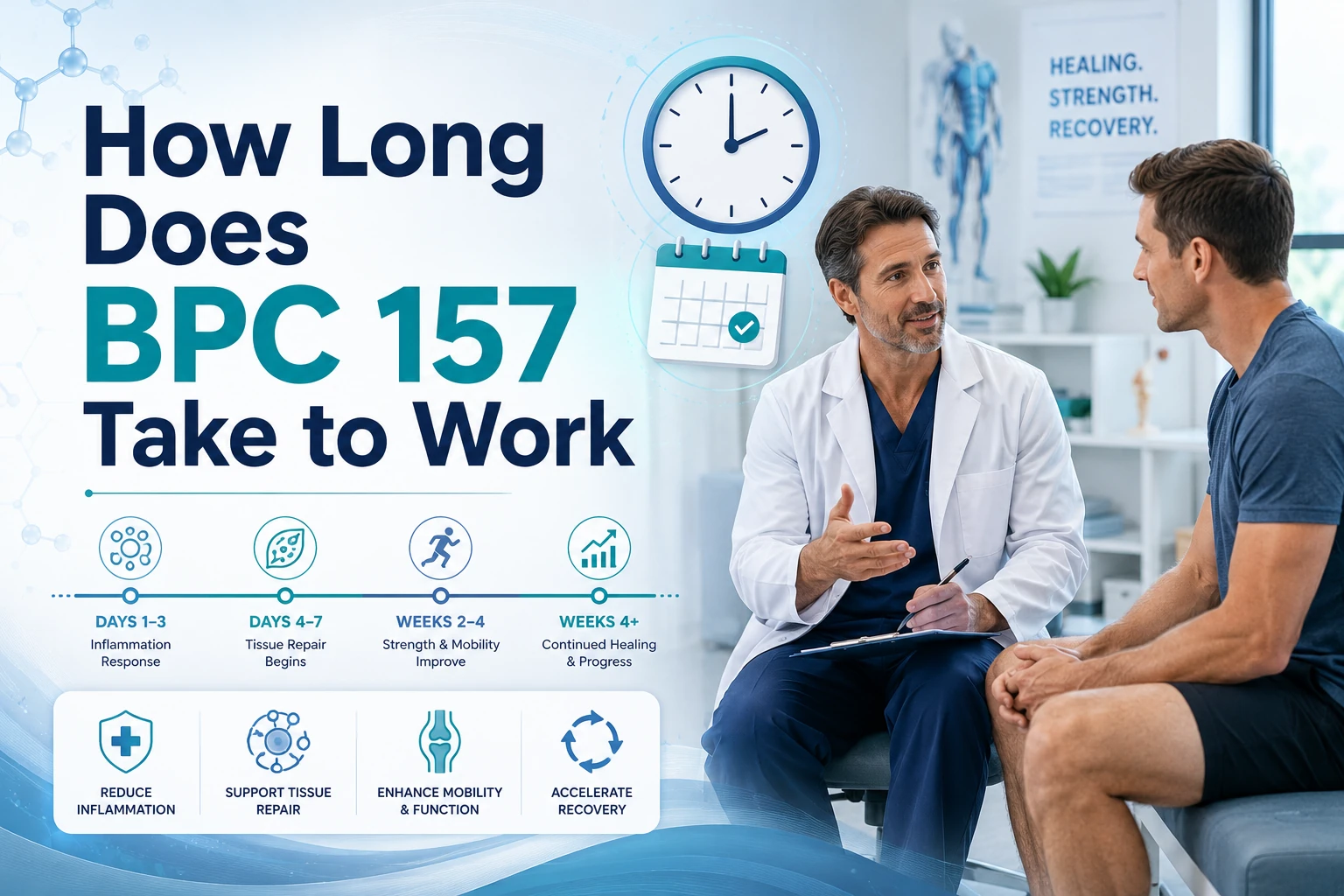
BPC-157 is best known for supporting tissue repair, and its results tend to show up faster than hormone-optimization peptides.
Preclinical research on tissue reattachment and healing found measurable structural changes within 2 to 4 weeks of consistent use, with the most complete healing documented around the 6 to 8 week mark.
Because BPC-157 does not yet carry full FDA approval, it’s typically used through a provider-guided, compounded protocol rather than an over-the-counter product.
If you’re recovering from joint pain and arthritis, understanding BPC-157’s own recovery timeline can help you know what to expect week by week.
Weight Loss Peptides (Semaglutide, Tirzepatide)
Weight loss peptides like semaglutide and tirzepatide work more gradually, since they’re designed to regulate appetite and blood sugar over months, not weeks.
In the SURMOUNT-1 trial, tirzepatide led to weight loss between 16% and 22.5% over 72 weeks, with most of that change building steadily rather than happening all at once.
A broader review of GLP-1 therapies found weight loss results ranging from 7% to 24%, depending on the specific peptide and dose.
If you’re exploring weight loss peptides or considering tirzepatide specifically, expect early appetite changes within the first few weeks and more significant weight loss building over 3 to 6 months.
Skin and Hair Peptides (GHK-Cu)
Copper peptides like GHK-Cu work by supporting collagen production and tissue repair at the skin level.
Research on GHK-Cu’s regenerative effects shows measurable improvements in skin firmness and density after about 12 weeks of consistent use.
Early changes in skin texture and hydration often show up within 2 to 4 weeks, but the more noticeable firmness and tone improvements build over the following two to three months.
The same gradual pattern applies to hair growth peptides, and reviewing real GHK-Cu before-and-after results can help set accurate expectations.
What Factors Speed Up or Slow Down Your Results?
Your results depend on dosing consistency, your metabolism, how well you time doses around meals, sleep quality, and the source and purity of your peptides.
Skipping doses, inconsistent timing, or low quality peptides are the most common reasons people don’t see results on schedule.
- Dosing consistency: Peptide receptors respond best to a steady, predictable schedule. Research on receptor desensitization shows that overly frequent or inconsistent dosing can blunt your body’s response over time, which is part of why staying consistent with your dosing schedule matters so much.
- Metabolism and body composition: People with faster metabolisms or more muscle mass often notice changes sooner, simply because their bodies process and respond to signaling molecules more efficiently.
- Timing around meals: Several peptides work best on a relatively empty stomach, since insulin released after eating can interfere with hormone signaling. Taking a peptide too close to a meal can blunt its effect.
- Sleep quality: Many peptides work alongside your body’s natural hormone cycles, which are closely tied to deep sleep. Poor sleep can slow down the very processes peptides are designed to support.
- Peptide sourcing and quality: Peptides from unreliable sources can be underdosed, contaminated, or improperly stored, all of which can delay or prevent results entirely.
The good news is that most of these factors are within your control.
Small adjustments, like taking your dose at the same time each day or timing it around meals correctly, can make a real difference in how quickly you notice results.
GET THE MOST OUT OF YOUR PEPTIDE TREATMENT
How to Tell If Your Peptide Therapy Is Working
You can tell peptide therapy is working by tracking steady improvements in energy, sleep, recovery, and appetite over several weeks, rather than expecting one dramatic change.
Confirming those shifts with your provider through regular check-ins gives you a clearer picture than guessing on your own.
Because peptide therapy builds gradually, it helps to track specific changes instead of waiting for one dramatic result.
Keep an eye on your energy levels, sleep quality, recovery after exercise, and any changes in appetite or soreness.
If you started peptide therapy for chronic fatigue, for example, you might notice steadier energy through the day before you see any changes on the scale or in the mirror.
Tracking these smaller shifts can help you recognize progress early, instead of only looking for the biggest, most visible changes.
Your provider can also track measurable markers, like hormone levels or body composition, to confirm the changes you’re feeling are backed by real data.
Regular check-ins make it easier to catch what’s working and adjust what isn’t.
What If You’re Not Seeing Results Yet?
Most peptides need 8 to 12 weeks of consistent use before you can fairly judge whether they’re working.
If you’ve hit that mark with no change at all, it’s worth reviewing your dosing consistency, timing, and peptide source with your provider before assuming the treatment isn’t right for you.
It’s easy to get discouraged if you don’t see changes right away, especially with gradual-acting peptides like those used for weight management or hormone optimization.
Before adjusting or stopping treatment, make sure you’ve given it enough time and that you’ve been consistent with dosing and timing.
If you’re still not seeing results after a full cycle, your provider may recommend adjusting your dose, switching peptides, or addressing another factor, like sleep or nutrition, that could be holding back your progress.
How Gard Wellness Solutions Supports Your Peptide Therapy Journey
Getting the timeline right starts with getting the protocol right.
At Gard Wellness Solutions, our peptide therapy program is built around your specific goals, whether that’s recovery, hormone optimization, weight management, or skin and hair health.
We start with a full health assessment to choose the right peptide, dose, and schedule for you, since the wrong fit is one of the most common reasons people don’t see results on time.
From there, we check in regularly to track your progress and adjust your protocol as needed.
If your goals go beyond a single peptide, our health optimization program looks at your hormones, metabolism, and overall wellness together, so every part of your plan works toward the same outcome.
Patients across West Palm Beach and the greater Palm Beach County area work with our team to build a protocol that fits their body and their timeline, not a generic one.
FAQs
How long does it take for peptides to work?
Most people notice early changes within 1 to 2 weeks, with more visible results building between weeks 6 and 12. Full results typically take 3 to 6 months, depending on the peptide and your consistency with treatment.
Do peptides work faster than other hormone treatments?
It depends on the peptide and the treatment being compared. Some peptides, like those used for sleep and recovery, work within a couple of weeks, while others, like weight loss peptides, build gradually over several months, similar to other hormone-based treatments.
How long does BPC-157 take to work for injury recovery?
Many people notice reduced soreness and improved mobility within 2 to 4 weeks of consistent use, with more complete healing typically reported around 6 to 8 weeks, depending on the injury and individual response.
Can you speed up peptide therapy results?
You can support faster results by staying consistent with your dosing schedule, timing doses correctly around meals, prioritizing sleep, and using properly sourced peptides. You cannot safely force results faster than your body’s natural signaling process allows.
What happens if peptides aren’t working after a few months?
If you’ve been consistent for 8 to 12 weeks with no noticeable change, it’s worth reviewing your protocol with your provider. They may adjust your dose, switch peptides, or address another factor, like sleep or nutrition, that could be limiting your results.
Do you need to take peptides on an empty stomach?
Many peptides work best when taken away from meals, since insulin released after eating can interfere with hormone signaling. Your provider can tell you the ideal timing for the specific peptide and goal you’re working with.