Most unmodified peptides, like BPC-157 or ipamorelin, clear your bloodstream within a few hours.
Peptides engineered to resist breakdown, like semaglutide and tirzepatide, stay active for five to seven days per dose, which is why they’re injected weekly.
How long you’d test positive, and how long you’d actually feel the effects, depend on the specific peptide, your dose, and how well your kidneys and liver work.
If you’ve started peptide therapy, or you’re still deciding whether to, you’ve probably asked yourself how long do peptides stay in your system.
It’s a fair question, and the honest answer is that it depends heavily on which peptide you mean.
Some peptides, like BPC-157, are mostly gone within an hour.
Others, like tirzepatide, are built to stick around for days so you only need one injection a week.
The numbers below come from FDA prescribing information and published pharmacology studies, not estimates pulled from forum posts.
This guide walks through how long the most common peptides actually last in your body, what changes that timeline, and why a drug test result and an “I can still feel it working” result aren’t measuring the same clock.
SEE IF PEPTIDE THERAPY IS RIGHT FOR YOU
How Long Do Peptides Stay in Your System?
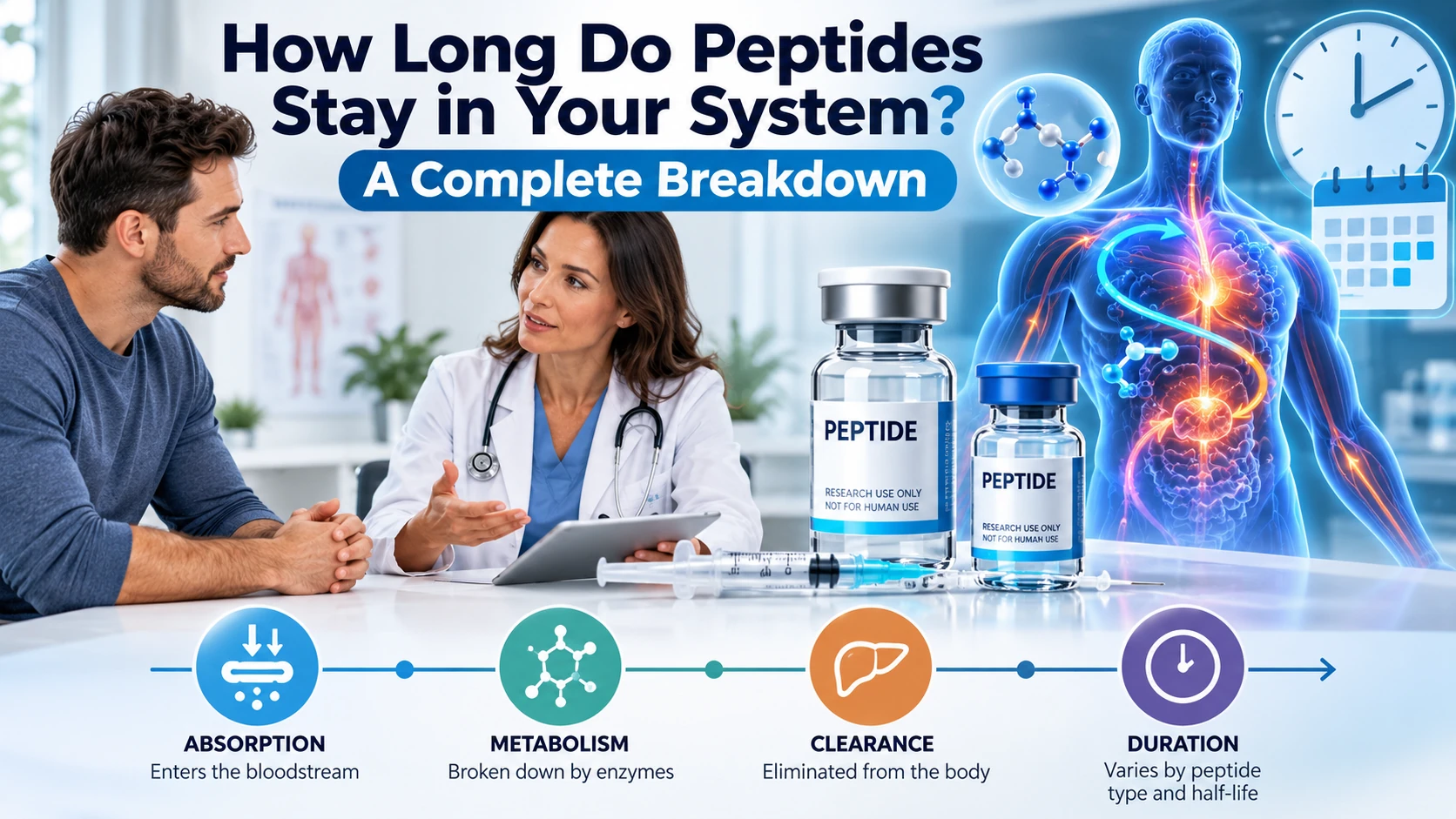
Peptides stay in your system anywhere from a few minutes to about a week, depending on the peptide.
Short, unmodified peptides like BPC-157 and ipamorelin typically clear within a few hours.
Peptides modified to bind albumin, like semaglutide and tirzepatide, remain active for five to seven days per dose, and it takes four to five of those cycles, roughly a month, to clear completely after you stop.
The variation comes down to the peptide’s size, shape, and whether it was deliberately modified to slow down how fast your body breaks it down.
A tiny, unmodified peptide is treated by your body like any other short protein fragment and gets filtered out fast.
A peptide attached to a fatty acid tail that binds blood proteins gets a much longer ride.
What Does Half-Life Actually Mean for a Peptide?
A peptide’s half-life is the time it takes for half of a given dose to leave your bloodstream.
After about five half-lives, less than 5% of the original amount is left, which most clinicians treat as fully cleared.
A peptide with a 2-hour half-life is essentially gone within a day; one with a 5-day half-life takes close to a month.
Clearance works the same way for peptides as it does for any other drug: your kidneys filter it out and enzymes in your blood and liver break it apart.
The two variables that determine how fast that happens are how widely the drug distributes through your body and how efficiently your organs remove it, and both of those vary from person to person.
Half-Life, Detection Window, and Duration of Effect Are Not the Same Thing
People often use “how long does it stay in my system” to mean three different things, and mixing them up leads to a lot of confusion.
Half-life is a purely chemical measurement: how fast the concentration in your blood drops by 50%.
It doesn’t care whether you feel anything or whether a lab can detect it.
Detection window is a lab question, not a biology question.
Specialized testing methods, like the liquid chromatography techniques anti-doping labs use, can identify peptide fragments at concentrations far below what a standard panel can measure, which means a sensitive test can often find a peptide long after its half-life suggests it should be gone.
Duration of effect is the one people actually care about day to day.
A single injection of CJC-1295 kept growth hormone elevated for up to six days and IGF-1 elevated for nine to eleven days in one published clinical trial, even though the peptide itself clears much faster than that.
The effect and the molecule are not running on the same clock.
How Long Do Common Peptides Stay in Your System?
Half-lives across common peptides range from under 30 minutes for BPC-157 to about a week for semaglutide.
Here’s where the peptides people ask about most actually land.
Typical Peptide Half-Lives at a Glance
- BPC-157: under 30 minutes
- Ipamorelin: about 2 hours
- PT-141 (bremelanotide): about 2.7 hours
- GHK-Cu: cleared quickly from blood, which is why it’s redosed often
- Tirzepatide: about 5 days
- Semaglutide: about 1 week
- CJC-1295: growth hormone effects sustained 6 to 11 days per dose
Weight Management Peptides (Semaglutide, Tirzepatide)
Semaglutide and tirzepatide are built differently from most peptides on this list.
Both attach to albumin, the main protein in blood plasma, which slows down how fast your kidneys and liver can clear them.
Tirzepatide’s elimination half-life is about five days, according to its FDA prescribing information, and semaglutide’s is closer to one week.
That’s why both are dosed once a week instead of daily, and why it takes about a month after your last dose for either to fully clear your system.
If you’re considering tirzepatide or comparing it against other weight management peptides, that long half-life is actually one of the main reasons it works well: steady blood levels mean steadier appetite control, rather than peaks and crashes.
Growth Hormone Peptides (CJC-1295, Ipamorelin)
CJC-1295 and ipamorelin are often used together, but they work on very different timelines.
CJC-1295 is designed to stay active far longer than most peptides on this list, which is why its growth hormone effects were measured in days rather than hours in the clinical trial referenced above.
Ipamorelin sits at the opposite end of the spectrum.
Its terminal half-life is about two hours, with growth hormone levels spiking and returning to baseline within a few hours of each dose, which is the mechanism behind ipamorelin’s benefits for recovery and sleep.
That contrast is exactly why pairing ipamorelin with CJC-1295 is common in practice.
One provides a sustained baseline, and the other adds short, sharp pulses on top of it.
Recovery Peptides (BPC-157)
BPC-157 is one of the most talked-about recovery peptides, and also one of the shortest-lived.
Its elimination half-life is under 30 minutes following injection in pharmacokinetic studies, meaning it’s substantially cleared from the bloodstream within a few hours.
That fast clearance is part of why BPC-157’s reported benefits for joint pain and tissue repair depend on consistent, repeated dosing rather than one large injection.
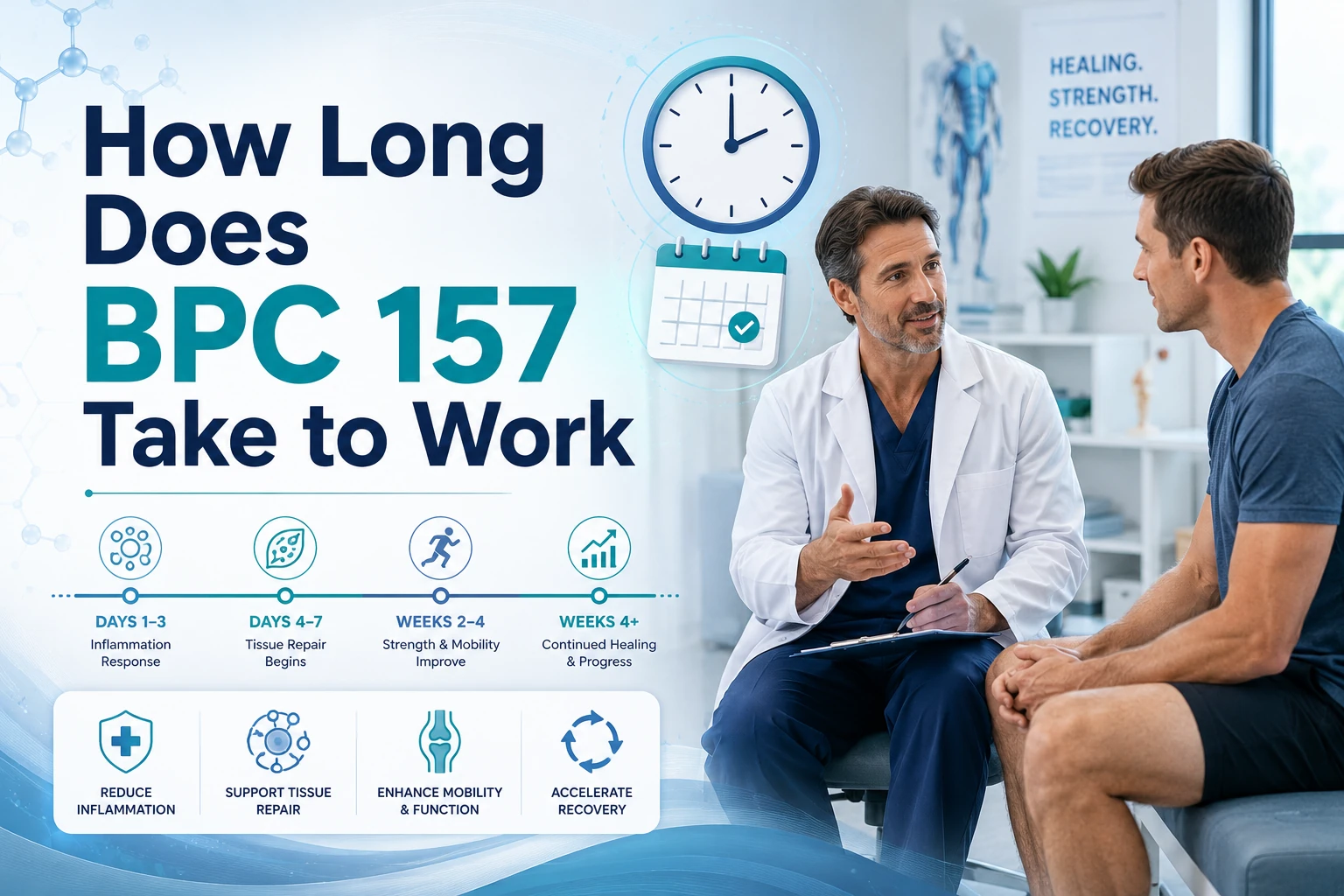
If you’re weighing BPC-157’s broader benefits against how quickly it leaves your system, how long it takes to start working is really the more useful question than how long it stays detectable.
Sexual Health Peptides (PT-141)
PT-141, also known as bremelanotide, works on a much shorter timeline than the weight management peptides above.
Its mean terminal half-life is approximately 2.7 hours, based on FDA-reviewed prescribing information for the approved version, Vyleesi.
That short window is intentional.
PT-141 is designed to be used as needed, roughly 45 minutes before sexual activity, rather than as a daily or weekly maintenance peptide.
Skin and Hair Peptides (GHK-Cu)
GHK-Cu is different from most peptides on this list because small amounts already occur naturally in your body, and those levels drop as you age, from about 200 ng/mL in your 20s to about 80 ng/mL by your 60s, according to one widely cited review.
Because only a small fraction of a topical or injected dose reaches active tissue, GHK-Cu protocols typically involve more frequent dosing than once-weekly peptides like tirzepatide.
If you’re using it for hair restoration, your provider will set a schedule around that shorter working window rather than a one-size-fits-all timeline.
What Affects How Long a Peptide Stays in Your Body?
How long a peptide stays in your body depends mainly on your dose, how it’s injected, and how well your kidneys and liver clear it from your blood.
Larger people, older adults, and anyone with reduced kidney or liver function typically clear peptides more slowly than the average research study participant.
Dose and Injection Site
Every half-life number in this guide comes from a specific, measured dose.
Take more of a peptide, and you simply give your body more to clear, which extends how long it’s detectable even though the half-life itself doesn’t change.
Injection site and depth matter too.
Subcutaneous injections, the most common method for peptide therapy, tend to absorb more slowly and steadily than intramuscular or intravenous doses, which can stretch out the practical timeline.
This is one reason BPC-157 dosing schedules favor smaller, more frequent injections over one large dose.
Kidney and Liver Function
Your kidneys and liver do most of the work of clearing a peptide from your blood.
Reduced function in either organ can meaningfully extend how long a drug, including a peptide, stays in circulation, since both are responsible for breaking it down and filtering it out.
This is part of why a peptide therapy program should start with bloodwork rather than a generic protocol.
Age, body composition, and existing health conditions all affect how efficiently your organs do this job.
Whether the Peptide Is Built to Resist Breakdown
Not all peptides are created equal when it comes to durability.
Peptides engineered to bind albumin, the most abundant protein in blood plasma, resist being filtered out by the kidneys and broken down by circulating enzymes, which is the entire design principle behind once-weekly medications like semaglutide and tirzepatide.
Unmodified peptides, like BPC-157 or ipamorelin in their natural form, don’t have that protection.
Your body treats them like any other short protein fragment and breaks them down quickly.
Do Peptides Show Up on a Drug Test?
Standard workplace and medical drug panels don’t screen for peptides at all.
They’re built to catch drugs of abuse, not therapeutic peptides.
Specialized anti-doping programs are different: they use lab methods sensitive enough to detect many banned peptides and their breakdown products for days to weeks after the last dose.
The World Anti-Doping Agency places most growth hormone-releasing peptides and growth hormone secretagogues on its prohibited list year-round, with no exception for competition timing.
Athletes subject to WADA testing should assume any growth hormone peptide carries real detection risk, even weeks after stopping.
Why Do Peptide Effects Often Outlast the Peptide Itself?
Peptide effects often outlast the peptide itself because the molecule doesn’t need to stay in your blood to keep working.
Many peptides trigger a chain of biological signals, like a growth hormone pulse or new collagen production, that continue well after the original peptide has broken down.
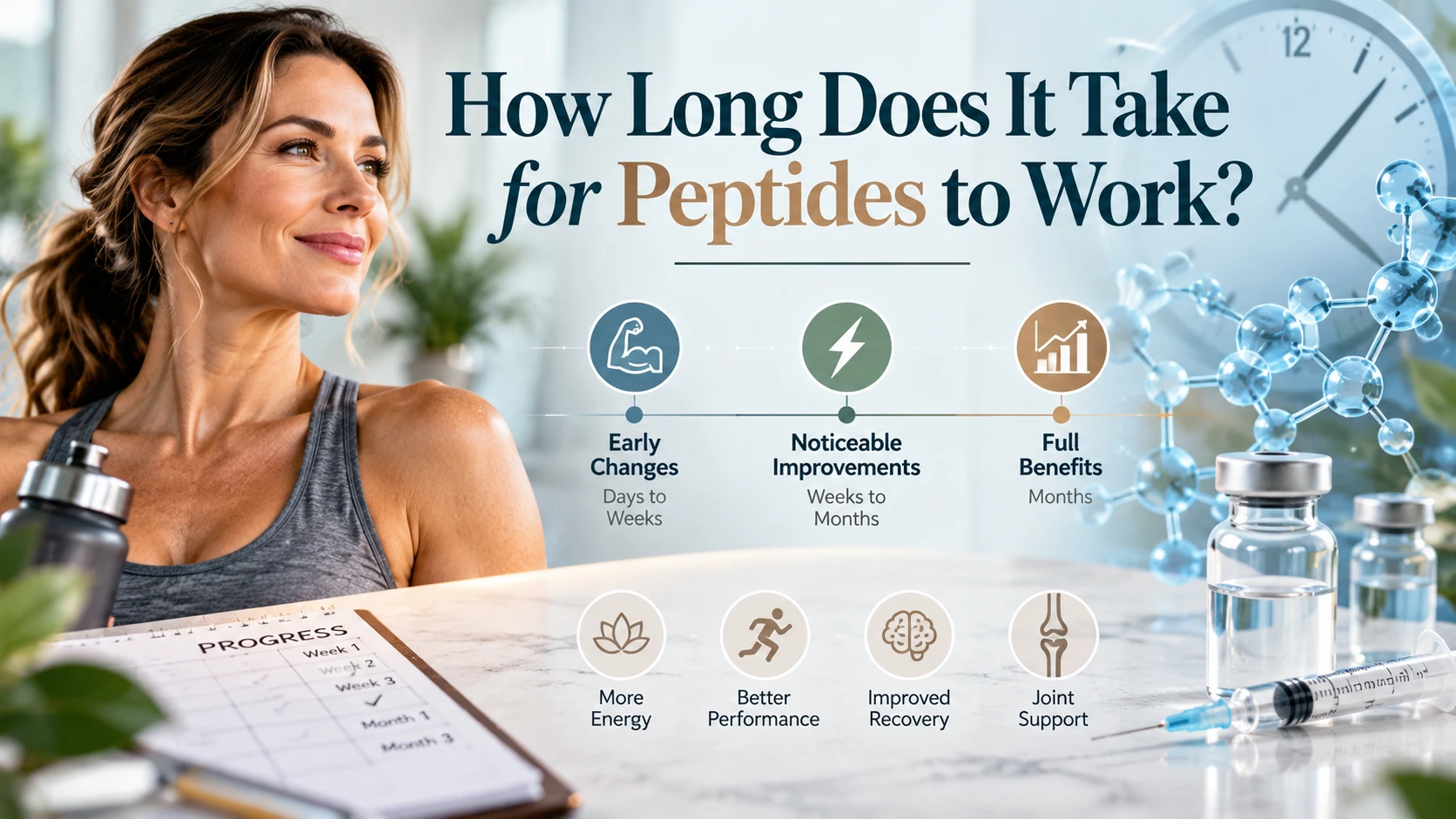
That’s also why the timeline for how long peptides take to start working and the timeline for how long they stay detectable are two different questions, even though people often ask them as if they were the same one.
GET ANSWERS TO YOUR PEPTIDE QUESTIONS
How Gard Wellness Solutions Approaches Peptide Therapy
Every peptide on this list clears the body differently, which is exactly why peptide therapy isn’t something to self-manage from a spreadsheet of half-lives found online.
At Gard Wellness Solutions, our peptide therapy program starts with bloodwork and a conversation about your goals, whether that’s recovery, weight management, or broader health optimization.
We adjust dose and timing based on how your body actually responds, not a generic protocol pulled from an online calculator.
If you’re already on a peptide and wondering whether your current schedule makes sense given your kidney and liver function, or your training or competition calendar, that’s a conversation worth having with our team at our Lantana, FL clinic rather than guessing on your own.
FAQs
Do peptides show up on a standard drug test?
No. Standard workplace and medical urine panels are designed to detect drugs of abuse like opioids, amphetamines, and THC, not peptides. You’d need a specialized anti-doping test, the kind WADA-regulated athletes face, to detect most peptides.
How long does BPC-157 stay in your system?
Research in animal pharmacokinetic studies found BPC-157’s elimination half-life is under 30 minutes, meaning it’s largely cleared from the bloodstream within a few hours of injection.
How long do semaglutide and tirzepatide stay in your system after you stop?
Semaglutide has a half-life of about one week, and tirzepatide’s is about five days. It typically takes four to five half-lives, roughly four to five weeks, for either to fully clear your system after your last dose.
Does a peptide’s half-life tell you how long its effects will last?
Not necessarily. Some peptides trigger biological changes, like a growth hormone pulse or new collagen formation, that continue working well after the peptide itself has left your bloodstream.
Can kidney or liver issues change how long a peptide stays in your body?
Yes. Your kidneys and liver are responsible for clearing peptides from your blood, so reduced function in either organ can extend how long a peptide circulates.
How long should you wait between peptide doses?
It depends on the specific peptide’s half-life and your treatment goals, which is why dosing schedules should come from a provider who knows your bloodwork rather than a fixed online chart.