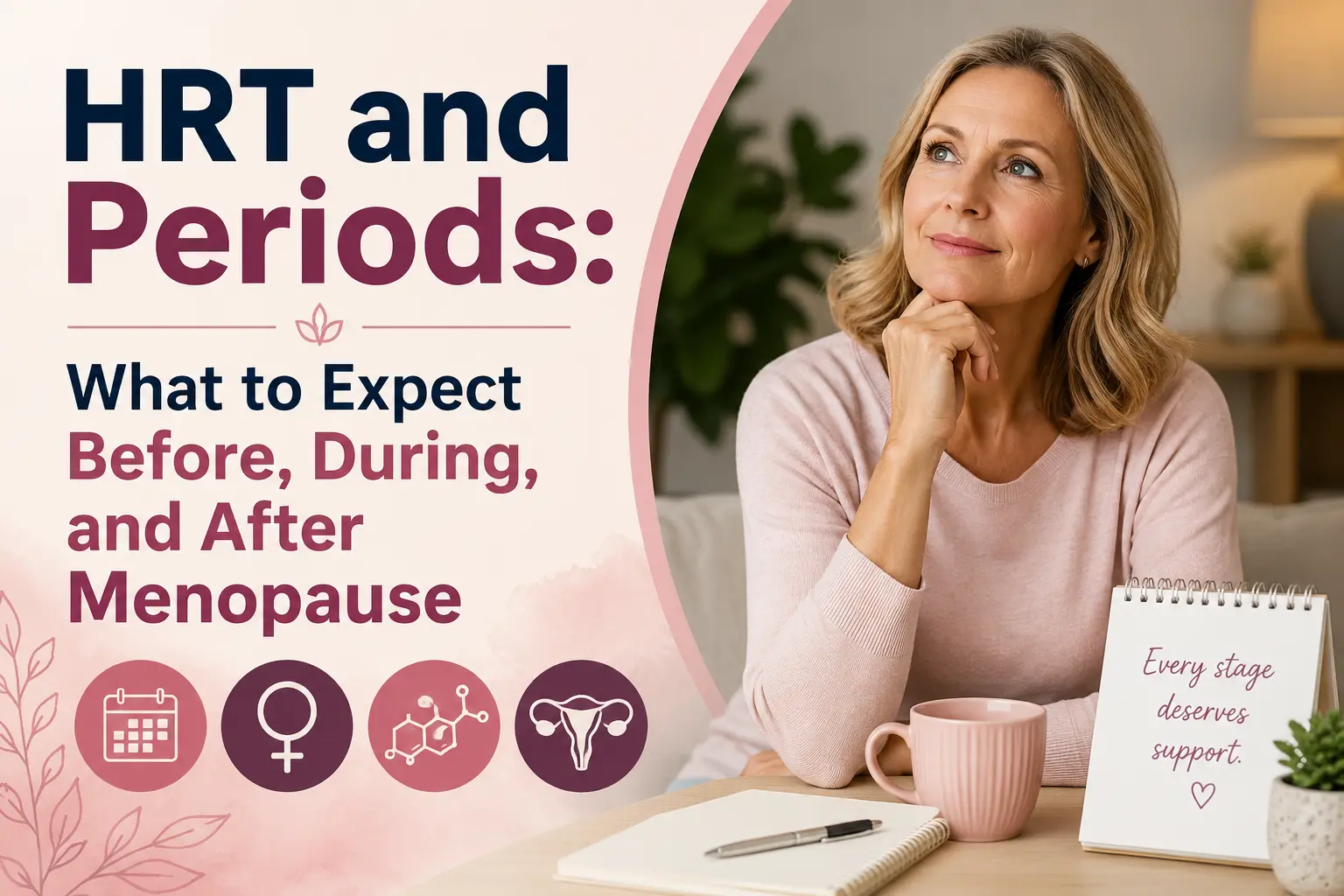
If you’re considering hormone replacement therapy (HRT) or have recently started treatment, you may be wondering how it will affect your menstrual cycle.
Can you still have periods on HRT?
Does HRT stop periods?
Is spotting normal?
The answer depends on your stage of menopause, the type of HRT you’re taking, and how your body responds to changing hormone levels.
For some women, HRT leads to lighter, more predictable periods.
Others continue having monthly bleeding, while some eventually stop having periods altogether.
Understanding what changes are normal can help you feel more confident as you navigate perimenopause, menopause, and hormone therapy.
GET THE MOST OUT OF YOUR HRT TREATMENT
Quick Answer: How Does HRT Affect Periods?
HRT can affect periods in different ways depending on the type of treatment and where you are in the menopausal transition.
Some women continue having periods while taking HRT, especially during perimenopause.
Others experience lighter or more regular bleeding, while women using certain types of HRT may eventually stop having periods altogether.
Spotting and breakthrough bleeding can also occur, particularly during the first few months of treatment.
Can You Still Have Periods While Taking HRT?
Yes, it’s possible to continue having periods while taking HRT.
Many women begin HRT during perimenopause, when their ovaries are still producing hormones and ovulation may still occur.
Because HRT supplements hormones rather than shutting down natural hormone production, periods may continue for some time.
Whether you continue having periods often depends on:
- Your age
- Whether you’re in perimenopause or menopause
- The type of HRT you’re taking
- Your body’s natural hormone production
Women who are still having periods before starting HRT should generally expect some ongoing bleeding initially.
Perimenopause HRT and Periods: What Changes Are Normal?
Understanding the relationship between perimenopause HRT and periods is important because this is often when women first seek treatment for menopausal symptoms.
Perimenopause can last several years before menopause.
During this stage, estrogen and progesterone levels fluctuate significantly, leading to unpredictable menstrual cycles.
Common changes during perimenopause include:
- Irregular periods
- Heavy periods
- Light periods
- Missed periods
- Shorter cycles
- Longer cycles
- Spotting between periods
Many women start HRT to help manage symptoms such as hot flashes, sleep disturbances, mood changes, and vaginal dryness.
While HRT can improve these symptoms, it does not immediately stop the hormonal fluctuations that occur during perimenopause.
As a result, women may continue experiencing irregular bleeding for a period of time after starting treatment.
Some women notice:
- More predictable cycles
- Reduced menstrual flow
- Less severe symptoms
- Fewer hormonal swings
Others may continue experiencing irregular periods until they reach menopause naturally.
Does HRT Stop Periods?
One of the most common questions women ask is whether HRT stops periods completely.
The answer depends on the type of HRT being used.
Continuous Combined HRT
Continuous combined HRT contains both estrogen and progesterone and is generally prescribed after menopause.
This type of therapy is designed to reduce and eventually eliminate monthly bleeding.
Many women stop having periods within several months of starting treatment.
However, spotting and light bleeding are common during the adjustment period.
Sequential (Cyclical) HRT
Sequential HRT is often recommended for women who are still having periods or who are in perimenopause.
Estrogen is taken continuously, while progesterone is taken for part of the month.
This approach commonly results in a regular monthly bleed that resembles a menstrual period.
Estrogen-Only HRT
Estrogen-only HRT is typically prescribed for women who have had a hysterectomy.
Because treatment plans vary, the effect on bleeding patterns can differ between individuals.
Can HRT Cause Heavier Periods?
In some cases, yes.
Women who begin HRT during perimenopause may notice heavier periods initially.
This can occur because hormone therapy affects the uterine lining, which may temporarily change bleeding patterns.
For some women, these changes improve as the body adjusts.
However, heavy bleeding should not be ignored, especially if it:
- Interferes with daily activities
- Requires frequent pad or tampon changes
- Continues for several months
- Occurs after menopause
Persistent heavy bleeding should always be discussed with a healthcare provider.
Why Am I Bleeding After Starting HRT?
Bleeding after starting HRT is one of the most common concerns women have.
In many cases, some spotting or light bleeding is a normal response as the body adapts to changing hormone levels.
Hormones influence the uterine lining.
When hormone levels change, the lining may thicken or shed differently than before, resulting in temporary bleeding.
Common causes include:
- Hormonal adjustment
- Breakthrough bleeding
- Changes in the uterine lining
- Missed doses
- Starting a new HRT regimen
- Switching medications
- Dosage adjustments
For many women, these symptoms improve within the first few months of treatment.
Is Spotting on HRT Normal?
Yes, spotting on HRT is often normal, particularly during the first three to six months.
Light spotting is more common when:
- Starting HRT for the first time
- Increasing or decreasing dosage
- Changing formulations
- Beginning continuous combined HRT
While occasional spotting is expected, persistent bleeding should be evaluated by a healthcare provider.
HRT and Postmenopausal Bleeding
Postmenopausal bleeding refers to any vaginal bleeding that occurs after menopause has been reached.
While some bleeding can occur when first starting HRT, especially continuous combined HRT, unexpected bleeding after menopause should always be discussed with a healthcare provider.
Many causes are harmless, but evaluation is important to rule out underlying conditions and ensure treatment remains appropriate.
When Should You See a Healthcare Provider?
You should contact a healthcare provider if you experience:
- Heavy bleeding
- Bleeding after menopause
- Bleeding that continues beyond six months
- Bleeding that starts after a long period without bleeding
- Pelvic pain
- Significant changes in bleeding patterns
Although these symptoms do not automatically indicate a serious problem, they should be evaluated.
Can HRT Help With Heavy or Irregular Periods?
For many women, HRT can help improve heavy or irregular periods caused by hormonal fluctuations during perimenopause.
Potential benefits include:
- More predictable cycles
- Reduced menstrual flow
- Less severe cramping
- Improved hormonal balance
- Better symptom control
Women often notice the greatest improvements once hormone levels have had time to stabilize.
How Long Does It Take for HRT to Affect Periods?
How long HRT takes to work varies from person to person.
Patience is important during the adjustment period, as your body may need time to respond to treatment.
Factors That Affect HRT and Period Changes
Several factors influence how HRT affects menstrual cycles, including:
- Age
- Perimenopause versus menopause status
- HRT formulation
- Hormone dosage
- Consistency of treatment
- Individual hormone sensitivity
- Underlying gynecological conditions
Because every woman experiences menopause differently, responses to HRT can vary significantly.
Final Thoughts: HRT and Periods
HRT and periods are closely connected, particularly during perimenopause when hormone levels fluctuate significantly.
Depending on the type of hormone therapy used, women may continue having periods, experience more predictable bleeding, notice lighter cycles, or eventually stop menstruating altogether.
Spotting and temporary bleeding are often normal when starting HRT, but heavy, persistent, or unexpected bleeding should be evaluated by a healthcare provider.
Understanding what changes to expect can help you feel more informed and confident as you navigate hormone therapy and the menopausal transition.
FAQs: HRT and Periods
What happens if you get a period on HRT?
Getting a period while taking HRT can be normal, especially if you’re in perimenopause or using sequential (cyclical) HRT. Hormone therapy can affect the lining of the uterus and may cause regular withdrawal bleeding, spotting, or changes in your menstrual cycle. The type of bleeding you experience often depends on the type of HRT you’re taking and where you are in the menopausal transition.
Should I stop HRT if I get my period?
You should not stop HRT simply because you experience bleeding or a period unless your healthcare provider advises you to do so. Some bleeding is expected when starting HRT or adjusting your treatment. However, if bleeding is heavy, persistent, or occurs after menopause, it’s important to speak with your healthcare provider for further evaluation.
Does bleeding on HRT mean too much estrogen?
Not necessarily. Bleeding on HRT can occur for several reasons, including your body adjusting to treatment, breakthrough bleeding, or changes in the uterine lining. While hormone balance may play a role in some cases, bleeding does not automatically mean you’re receiving too much estrogen. Your healthcare provider can determine whether any adjustments to your treatment are needed.
Will my period come back if I go on HRT?
It can. Women who begin HRT during perimenopause may continue having periods or notice changes in their cycle because their ovaries are still producing hormones. In some cases, HRT may trigger bleeding that resembles a period, particularly with sequential HRT. The effect varies depending on your age, hormone levels, and treatment plan.
What if I get my period while taking progesterone?
If you’re taking progesterone as part of a sequential HRT regimen, experiencing bleeding or a period-like withdrawal bleed is often expected. Progesterone helps regulate the uterine lining, and bleeding may occur when progesterone is stopped or cycled. If the bleeding is unusually heavy, prolonged, or unexpected, contact your healthcare provider.
How long does it take for HRT to stop periods?
There is no universal timeline. Women using continuous combined HRT often notice bleeding becomes lighter and less frequent over several months, with many eventually stopping periods altogether. For some women, it may take three to six months or longer for bleeding patterns to stabilize. Women using sequential HRT may continue having regular monthly bleeding as part of their treatment plan.